Spoilers
This is, quite simply, one of the best SF novels I've ever read. It's that rarest of beasts, a hard SF novel that's actually readable.
The story provides an interesting spin on the alien invasion scenario. A response to a signal sent out by a SETI equivalent in Culture Revolution era China is detected by scientist Ye Wenjie. The message she receives warns her not to respond, as the sender's civilisation is seeking to escape its homeworld for a more hospitable planet, and if she responds they'll be able to pin-point the origin of the signal and send their invasion fleet.
Reasoning that a sufficiently scientifically advanced civilisation must also have arrived at a high level of moral sophistication, Ye responds, hoping that the invading 'Trisolarans' will conquer the Earth and, being completely outside human history and thus far more objective about our state of affairs, will be able to offer solutions to humanity's problems.
The book initially spends a lot of time familiarising us with the insanity of the Cultural Revolution (don't think that this necessarily marks this book out as anti-establishment: the official Party line in China is that the Cultural Revolution was a disastrous error of judgement on Mao's part), as well as the possible consequences of extraterrestrial contact. Perhaps most interestingly, though, is the author's defence of reason and rationality. Indeed, there's so much scientific-Promethean sentiment in this book that I almost got an accelerationist contact high.
Early on, we learn that there's a growing movement claiming that our ability to understand the universe is far more restricted than had previously been supposed. Seeking to apply the scientific method to science itself, the Frontiers of Science movement hold that fundamental science has reached its limit. The particle accelerators around the world have stopped generating identical results, suggesting that at a certain basic level, the universe is utterly random and cannot be comprehended.
Furthermore, one character notes that there's a growing cultural hostility towards scientific and technological progress, a burgeoning strain of primitivism that pushes for the abandonment of the projects of techno-science in favour of a return to nature. What we learn, though, is that this movement is a product of the Trisolarans attempt to undermine our ability to offer resistance when they arrive. Shocked by how rapid human technological development has been in the last century, they work with their collaborators on Earth to frustrate scientific research, in particular fundamental theory. Indeed, even the lack of identical results from the particle accelerators is revealed to be part of their plot.
There's something quite classically SF about that, this strong feeling that it's only scientific rationality that will bring humanity triumph, almost clichéd in fact. Indeed, some of their human collaborators even view the Trisolarans in religious terms. Perhaps it's a little on-the-nose, but there's still something really quite pleasing, from an accelerationist perspective at least, about how the efforts to undermine technological and scientific enterprise is painted as a betrayal of humanity.
Wednesday, 28 October 2015


Friday, 9 October 2015
Accelerationism talk at the Catalyst Club: 08/10/2015
The following is the talk I gave on Accelerationism at the Catalyst Club on Thursday, 8th October, 2015. If anyone involved with the Club is reading this, thanks again for having me.
To what I am certain will be the heartbreaking disappointment of my Neoreactionary readers, this is of a Left Accelerationist tendency.
Now, given the restraints of only having about 15 minutes to speak, I had to summarise what would have been worth taking my time explaining, simplify what is properly approached as complex, skip over points it would have been worth dwelling on, and miss out some stuff completely (most notably, I only name check the CCRU et al). So you'll notice that the focus is on broad themes, rather than fine details.
Any outright inaccuracies are just down to me not doing enough research.
My plan is to use this skeleton as the jumping off point for a later, longer and more detailed piece on the subject. This being said, I'm not sure a single promise I've made about where I'm going to take this blog has actually come about, so don't hold your breath.
I'll include a list of sources I used when researching this at the end of the text.
Finally, thanks to my good friend Rob for the constructive criticism throughout the writing of this.
To what I am certain will be the heartbreaking disappointment of my Neoreactionary readers, this is of a Left Accelerationist tendency.
Now, given the restraints of only having about 15 minutes to speak, I had to summarise what would have been worth taking my time explaining, simplify what is properly approached as complex, skip over points it would have been worth dwelling on, and miss out some stuff completely (most notably, I only name check the CCRU et al). So you'll notice that the focus is on broad themes, rather than fine details.
Any outright inaccuracies are just down to me not doing enough research.
My plan is to use this skeleton as the jumping off point for a later, longer and more detailed piece on the subject. This being said, I'm not sure a single promise I've made about where I'm going to take this blog has actually come about, so don't hold your breath.
I'll include a list of sources I used when researching this at the end of the text.
Finally, thanks to my good friend Rob for the constructive criticism throughout the writing of this.
***
Capitalism is an extraordinary thing.
There has never been a force as productive, innovative or as liberating as
capitalism, a fact well recognised by Marx. Capitalism has chewed up the old
world and transformed the life of humanity: at least, for the most part. The
release of productive energy, both physical and mental, accomplished by
capitalism has unleashed the potential for scientific and technological
development, as well as radical social change, on a global scale. That has never
before been possible.
However, many insist that
capitalism needs to be overthrown, dismantled, fought against and, in a word,
destroyed. Of course, even with the huge gains it has made taken into account,
only a fool would claim that capitalism is by any means perfect. But it would be equally foolish, if not dishonest, to
claim that any of the alternatives we have attempted have worked better. What
if the standard critique of capitalism has been going in the wrong direction by
trying to curtail, diminish, and do away with it? Perhaps we do not need deceleration,
but instead the opposite: that is what accelerationism is all about.
Accelerationism
emerged out of the often esoteric works of Gilles Deleuze, Feliz Guattari and
Jaques Lyotard, as collated, synthesised and remixed by Nick Land, Sadie Plant
and the Cybernetic Culture Research Unit in the 1990s. This peculiar fusion of thinkers,
methods and styles produced a strange and sometimes frightening
reinterpretation of capitalism and its potential to change the world. It held
that the task at hand was not the revolutionary destruction of the market, but
instead its acceleration and evolution. In Deleuze and Guattari’s much quoted
words: ‘Which is the revolutionary path? ... Is there one? To withdraw from the
world market…? Or might it not be to go in the opposite direction? To go still
further…in the movements of the market…not to withdraw from the process, but to
accelerate the process…’
What is this process? For Deleuze
and Guattari, it is the process whereby capitalism decodes and deterritorialises
the flows of production. Now, I’m not sure anyone actually quite knows what that
means (it isn’t exactly uncommon for Continental philosophers to just make up
words and never feel the need to include a glossary), so we will have to take a
moment to unpack these expressions.
I think
they mean exactly what they sound like. They mean the undoing of codes, the
disruption of territories. A code is the form of something, the way something
occurs, a set of instructions (for example, a code of honour). To ‘decode’ means
to undo a code, to abolish or deconstruct a set of instructions. The act of
decoding allows something to take another form, to occur in a different way. A
territory is the location upon which something occurs or by which something is bound.
It is both a limit and a plane of actualisation. Deterritorialisation is the
act by which a plane is undermined and demolished, thus displacing limits and
allowing new potentials for actualisation. In other words: to decode and
deterritorialise simply means to create opportunities for new things to happen,
or for old things to happen in new ways.
Decoding
and deterritorialising. When have these things happened? They happened in this
country. We saw it during the industrial revolution, we saw it during and after
the World Wars, when new realities were forced upon an old society. We saw it
when the edifice of the Soviet state was collapsed by its inability to properly
direct productive forces. We are seeing something similar in China and India.
We see it every time an underdeveloped country is acted upon by the forces of
the world market. We are, globally, on average, freer and with a better chance
of not dying prematurely than we have ever been before: that is a disruption of the prior order. 2015 has far less in
common with 1915 than 1915 had with 1815, and although we must not try to reduce
all of this change down to a single factor, it is supremely foolish to not
recognise the positive impact the breakthrough of market forces has had upon
our world. You might say: it was the utopian ideals of the Enlightenment that
made us freer! It was the downfall of religious superstition that gave us
science! And you are right…but it is only a general increase of wealth, individual
self-determination and opportunities for voluntary association that allowed us
to have those things in the first place.
This is
where we must start to consider accelerationism as a critique of the mainstream
Left. Lyotard makes the claim in his work Libidinal
Economy that ‘…the English unemployed did not become workers to survive,
they…enjoyed the hysterical, masochistic…exhaustion it was of hanging on in the
mines, in the foundries, in the factories…they enjoyed the decomposition of
their personal identity, the identity that the peasant tradition had
constructed for them…’ Cultural theorist Mark Fisher helps us extract something
tangible from this bizarre flurry of prose: which of us, he asks in his essay Terminator vs Avatar, wants to go back
to our existence before the mines, the factories, the foundries? Who really wants to trade in all our
technology and science and security and liberty for a nostalgic existence
moralised and spiritualised as more ‘authentic’, and a community more ‘organic’?
What do these words even mean?
For
an accelerationist, there is only one word for the call to return to an
existence untouched by capitalism, technology and market forces: ‘reactionary’.
We are capitalized. We are
part of the market. Do we really want
to live off of the land again? Although some of us might say yes, most of us
would not. Capitalism was an escape for our ancestors. Yes, they lost the cosy,
‘authentic organicism’ of rural life, but wasn’t that a sacrifice worth making?
Didn’t it liberate them, and us, from the tyranny of living by the seasons,
fearing the next bad harvest? The Russian futurist Nikolai Federov, who called
for the complete mastery of nature by man, considered nostalgia for nature a
mark of someone who lives comfortably outside of its vindictiveness: indeed,
for Federov, the love of nature is tantamount to the love of death. Capitalism
broke us out of nature.
Deleuze and
Guattari consider the origins of capitalism, and wonder why it was that
capitalism happened here, in Europe,
and not in China or the Islamic world. Not because they lacked technical skill:
rather, they suggest, because these were societies that were still too caught
up in themselves. This is perhaps
especially true of Imperial China, with its emphasis on harmony, hierarchy and
serenity. The despotic state was too well developed, too far extended, for the
initial conditions that capitalism appears to need. Capitalism needs a
thousand, thousand things to occur, but perhaps it especially needs disorder
and a desire to push forwards and outwards.
Capitalism creates an explosion of individual
and group desires that are not caught
up in the apparatus of the social order. The market grows to satisfy these
desires, and to create new ones. The result of this is a new way of doing
things that no other socio-economic arrangement has seemed capable of
outcompeting. The world was opened up by capitalism, decoded and
deterritorialised by capitalism, but in the end closed up again by capitalism,
recoded and reterritorialised by capitalism too.
There’s the
rub.
Although
produce no longer goes to the manor house, and fealty is no longer owed to the
lord of the land, new institutions, new codes and territories, have arisen out
of the machinery of the market. The new code is capital itself. The new
territory is the nation state. Production is almost universally routed through
capital. Desire follows the same path, being so caught up in the productive
system that, short of a complete and violent rejection of it (which I maintain
is a primitivist gesture par excellence),
the two are almost identical. This has had the effect of blinding us to the
sheer possibilities of what is already at hand. We seem peculiarly incapable of
recognising the potential of the technology that capitalism has given us.
Consider Facebook: doesn’t it in many ways fulfil the utopian ambition of being
able to converse with other, like-minded people instantaneously, irrespective
of borders or geography? And yet, even though this could be a powerful tool for collaborating on projects in a way
that is international, almost post-national, our use of it presently is best described
as ‘uninspired.’
I feel that
this is true of all our technology. The feminist Shulamith Firestone summed up
our lack of imagination well when she imagines a scientist saying: ‘Dear, I
discovered how to clone people at the lab today. Now we can go skiing in
Aspen.’ Our energy, our productivity and our imagination is primarily directed
towards the narrow aims of the market, curtailing the possibility of exploring
new forms of innovation, new projects, new ways of being.
It is here
where we must distinguish between left-and right-accelerationism. Right-accelerationism,
which is closely aligned with the techno-commercialist wing of Neoreaction, calls
for the acceleration of capitalism itself, for the indefinite expansion of the
marketplace, replacing even the functions of government itself. It holds that
the productive potential within capitalism can only occur in the capitalist
form, and that this form will continue to outcompete all opposition, consuming
whatever is left of the commons. Left-accelerationism instead seeks something
different: it seeks to rediscover those decoding and deterritorialising
tendencies that tore apart feudalism, and to turn them against capitalism
itself.
This must
not be the same as previously attempted forms of revolutionary socialism. The
revolutionary event, if it is to take firm hold of a society, must rely on
political Terror, in either an extreme and sudden form, or else in the form of
a persistent feeling of dread: the history of the Soviet Union and China give
us ready examples of both methods. The result of these centrally planned
alternatives to the market were only ever variations of what Nick Land described
as ‘Platonic-Fascist top down solutions that always screw up viciously.’ The
work of rediscovering what was and is innovative, transformative and liberating
within capitalism must occur within
capitalism. We must build upon what is here now, and not in the form of
piecemeal, socially democratic reformism- this project must be radical, it must
be different. But it cannot be as dramatically divorced from reality as past
attempts have been. The task at hand is to work with the already existing forces of production and desire, not
against them, to push production and desire beyond capitalism’s boundaries, to
rediscover the urge to go forwards and outwards.
If the Left
wants to be a real force for change, it needs to upgrade.
To quote the Manifesto for an Accelerationist Politics by Alex Williams and Nick
Srnicek: ‘The habitual tactics of marching, holding signs, and establishing
temporary autonomous zones risk becoming comforting substitutions for effective
success. “At least we’re doing something” is the rallying cry of those who
privilege self-esteem rather than effective action. The only criterion of a
good tactic is whether it enables significant success or not.’ Williams and
Srnicek, perhaps deliberately, recall the moto the Chinese Communist Party
deployed during the shift from top-down central planning to their current
market economy: ‘Practice is the Sole Criterion for Testing Truth.’
The accelerationist Benedict
Singleton describes the mechanism of a trap: a trap is something that turns the
characteristics of something against it - the rabbits struggle to escape only
tightens the snare. That is a model for us to explore. We must learn to set
traps for desire, for self-interest, for competition, production, and capital,
to turn them to different ends. Reorientation is as important as acceleration.
Experiment. Communicate. Network.
Above all: learn. Learn how to
analyse the movements and fluctuations of the market. Learn how to make use of
the technology already available to us in new ways, ways its creators did not
intend or even envisage. Learn new ways of being together with both your allies
and your opponents. Learn what capitalism does right, what it does wrong, and
where the possible schizes between these things lie. Learn where the Left has
failed, and why. Learn, and prepare for a future that will not resemble the
past. Acceleration is inevitable, the question is can we avoid crashing and reach
escape velocity? In the words of Deleuze and Guattari: ‘in this matter, the
truth is that we haven’t seen anything yet.’
References
- Anti-Oedipus by Gilles Deleuze & Felix Guattari, trans. Robert Hurley, Mark Seem and Helen R. Lane (Bloomsbury Acedemic, 2013, London & New York)
- The Russian Cosmists: The Esoteric Futurism of Nikolai Federov and his Followers by George Young (Oxford University Press, Oxford, 2012)
- 'Libidinal Economy (extract)' by Jaques Lyotard; 'Terminator vs Avatar' by Mark Fisher; 'The Two Modes of Cultural History' by Shulamith Firestone; 'Manifesto for an Accelerationist Politics' by Alex Williams and Nick Srnicek; 'Maximum Jailbreak' by Benedict Singleton are all collected in #Accelerate: the accelerationist reader edited by Robin Mackay & Armen Avanessian (Urbanomic, 2014, Falmouth)
- 'Meltdown' by Nick Land is collected in Fanged Noumena, Collected Writings 1987-2007 by Nick Land, ed. by Robin Mackay & Ray Brassier (Urbanomic & Sequence Press, Falmouth & New York, 2014)
- http://deontologistics.tumblr.com/post/91953882443/so-accelerationism-whats-all-that-about
Sunday, 20 September 2015
Accelerationism and Pragmatism
Leafing through #Accelerate: the accelerationist reader for some inspiration for an upcoming talk on the subject, I came across some great imagery in Benedict Singleton's Maximum Jailbreak.
'The association of design and the trap runs deep... Hunting traps are, as Gell writes, 'lethal parodies' of their prey's behaviour. A human would be lucky to catch most other mammals unaided, but this can be redressed by an indirect strategy that makes use of their observed disposition: their inclination to eat certain kinds of food, in the example of bait; or a translation of their attempts to escape into the means of their demise, as in the snare. Understood in these terms, the maker of the trap mobilises and organises an ensemble of forces into new conjunctions...twist[ing] trajectories already at play in the environment in unexpected directions.' [Singleton, Benedict; 'Maximum Jailbreak' in #Accelerate: the accelerationist reader; Urbanonmic, Falmouth, 2014; p. 499]
Now, isn't that just what makes accelerationism interesting? What differentiates it from the standard Leftist critique, and, more importantly, from the pathological dreadfulness of 20th Century experiments in socialism? Look closely at what's being said: the mechanism of the trap functions by redirecting already existing energies and qualities in the prey. The trap can only function if it is designed with the actually existing qualities of the prey in mind: not based on an 'if', but on an 'is'. This is a lesson that needs to be learned by the Left, one of an absolute Realpolitik. The world and humanity are both constituted in particular ways. Human beings have certain characteristics and incentives that need to be recognised and worked with rather than against.
The deeper point Singleton is making here by drawing particular attention to the nature of the trap is one about good design in itself. Good, effective artifice is only that if it is grounded in reality, making use of materials as they really are, making use of the environment as it actually is, building these facts into its design from the moment of its conception.
The typical refrain from the Left is one of wishful thinking, of beginning by saying 'if only we could see through the fiction of nationhood!' or 'if only we could work for the common good rather than only for ourselves!' Ideals are all very well, more than that, useful in fact, but one cannot wish reality away. Any Promethean project that has as its aim post-capitalism, or a sufficiently transformed capitalism to barely resemble the present one, must seek to work with the actually existing energies and forces that shape the world, and with the human incentives that generate them.
You simply cannot dismantle the desiring-machines that produced the world market. What we can at least try to do is redirect their productive flows to different ends.
To consider Moldbug, discussing his theory of world-peace via way of corporate governance: 'So our theory of peace is a little different. It is reactionary rather than progressive, which means that it is designed to work with hominids not as they should be, angels without wings, but as they are: bipedal land apes.' Moldbug is supposing a false dichotomy here: there is nothing inherently reactionary about seeking to improve the world by reference to its actually existent characteristics, rather than idealised ones. This is simply pragmatism.
Accelerationism appeals to me because it seeks to work with these actually existent conditions, and to push them in new directions. Capitalism happened for a reason, because human beings are both competitive and co-operative, both selfish and altruistic. Any political or economic movement that does not seek to work with these qualities, but instead condemns them and tries to engineer them out of us, will arrive at nothing except catastrophe.
'The association of design and the trap runs deep... Hunting traps are, as Gell writes, 'lethal parodies' of their prey's behaviour. A human would be lucky to catch most other mammals unaided, but this can be redressed by an indirect strategy that makes use of their observed disposition: their inclination to eat certain kinds of food, in the example of bait; or a translation of their attempts to escape into the means of their demise, as in the snare. Understood in these terms, the maker of the trap mobilises and organises an ensemble of forces into new conjunctions...twist[ing] trajectories already at play in the environment in unexpected directions.' [Singleton, Benedict; 'Maximum Jailbreak' in #Accelerate: the accelerationist reader; Urbanonmic, Falmouth, 2014; p. 499]
Now, isn't that just what makes accelerationism interesting? What differentiates it from the standard Leftist critique, and, more importantly, from the pathological dreadfulness of 20th Century experiments in socialism? Look closely at what's being said: the mechanism of the trap functions by redirecting already existing energies and qualities in the prey. The trap can only function if it is designed with the actually existing qualities of the prey in mind: not based on an 'if', but on an 'is'. This is a lesson that needs to be learned by the Left, one of an absolute Realpolitik. The world and humanity are both constituted in particular ways. Human beings have certain characteristics and incentives that need to be recognised and worked with rather than against.
The deeper point Singleton is making here by drawing particular attention to the nature of the trap is one about good design in itself. Good, effective artifice is only that if it is grounded in reality, making use of materials as they really are, making use of the environment as it actually is, building these facts into its design from the moment of its conception.
The typical refrain from the Left is one of wishful thinking, of beginning by saying 'if only we could see through the fiction of nationhood!' or 'if only we could work for the common good rather than only for ourselves!' Ideals are all very well, more than that, useful in fact, but one cannot wish reality away. Any Promethean project that has as its aim post-capitalism, or a sufficiently transformed capitalism to barely resemble the present one, must seek to work with the actually existing energies and forces that shape the world, and with the human incentives that generate them.
You simply cannot dismantle the desiring-machines that produced the world market. What we can at least try to do is redirect their productive flows to different ends.
To consider Moldbug, discussing his theory of world-peace via way of corporate governance: 'So our theory of peace is a little different. It is reactionary rather than progressive, which means that it is designed to work with hominids not as they should be, angels without wings, but as they are: bipedal land apes.' Moldbug is supposing a false dichotomy here: there is nothing inherently reactionary about seeking to improve the world by reference to its actually existent characteristics, rather than idealised ones. This is simply pragmatism.
Accelerationism appeals to me because it seeks to work with these actually existent conditions, and to push them in new directions. Capitalism happened for a reason, because human beings are both competitive and co-operative, both selfish and altruistic. Any political or economic movement that does not seek to work with these qualities, but instead condemns them and tries to engineer them out of us, will arrive at nothing except catastrophe.
Saturday, 29 August 2015
Transmission
I've been playing around with this idea for a while, and it eventually cohered into this. I'm quite pleased with it, as I don't write fiction very often (hopefully none of you will get to the end of this and say 'I can see why!'). So, here it is, my first real crack at weird fiction. Enjoy.
The house was dark and cold. It was haunted by the smell of damp and cigarettes. The old soldier, wearing a thick jacket and wrapped in a heavy blanket, explained that he was behind on most of his bills, and had never really bothered to maintain the place anyway. The curtains were drawn, blotting out the grey late-evening sky. I shivered, and gratefully accepted the offered cigarette.
‘Mark told me you have an interesting story for me,’ I said. ‘I’m a collector of interesting stories.’
Mark was our mutual acquaintance. A conspiracy freak and self-described ‘guerrilla occultist’, he made a living from pulling together diverse threads of weirdness, tying them together into something interesting and selling them on. I made a point of sitting down with him every couple of months to see if he’d anything new for me. He could be easily plied with drink, money and a little flirting, and he never seemed to hold back much information. Two nights ago, in an authentically grim pub, he told me that he’d met someone who, he said, had been involved with the 70s-80s incarnation of a certain military unit, one that has a tendency of cropping up in conspiracy circles.
‘How the hell did you manage that?’ I asked.
He tapped his nose and grinned. ‘Can’t be sharing trade secrets with you, now can I? I’ve mentioned to him that I’ve got this friend who’s very keen on meeting people who’ve had certain experiences. And he’s keen on relating those experiences to someone. If you’re interested, and I’m sure you are, I can let you know what his address is.’
Two-hundred pounds later, there I was, sitting in the living room of a man out of modern myth.
His drawn face, coated with several days’ growth of stubble, was briefly illuminated as he lit his cigarette, drawing from it deeply. He might have been handsome once. He looked at me intently, like he was examining me. There was a coldness in his eyes that frightened me a little.
‘Yeah. I’ve got a story.’ His voice was almost without accent, but I thought I detected a trace of the North in it. ‘What’s Mark told you?’
‘That you were in the special forces a long time ago.’
‘He say when?’
‘Late 70s, early 80s.’
‘That’s right. What else?’
‘Not much, just that you wanted to tell someone your story.’
‘He mention I’m dying?’
I drew on my cigarette for a moment. ‘No. Is that why you’re telling me this? A confession?’
‘Partly. Yeah. I guess.’
I put the digital recorder on the table between us. Mark had assured me that this guy was comfortable with me using it, though he regarded it with suspicion.
‘What are you going to do with that afterwards?’ he asked.
‘I’ll write up a transcript of this to store in my private archives. It won’t be published elsewhere, if you don’t want it to be.’
‘Not much fussed really, but wait until they’ve stuck me in the oven until you print it, if you’re going to.’
‘How do you want to do this?’ I asked. He shifted in his seat a moment, pulled the blanket a little tighter around him.
‘I’ll talk. You want to know something in particular, you ask.’
I nodded.
‘I dunno when this happened exactly. They gave us all a drug, you see, so it’s difficult to remember. My theory is, they didn’t kill us in case they needed us again. Me and the boys, we were a special unit. Not SAS or SBS or Royal Marines, but drawn from all three, as well as the regulars. Idea was that we were reliable, tough bastards. That wasn’t all of it though, we’d all…we’d all seen something, or been involved with something we weren’t meant to talk about. Difficult to remember any of it with much detail, but…yeah.’
‘Tell me about the drug.’
‘I think they gave it to us after this last one, the one I wanna talk about. They must have dissolved the unit afterwards, or kept it going with other people… I only started remembering this stuff in the last few years.’
‘How did that happen?’
He lit another cigarette. He didn’t offer me one this time.
‘I was out on a walk, in the countryside, out there,’ he nodded towards the window. ‘And I lost track of time, it got dark and I realised I didn’t know where I was. Still, wasn’t exactly the first time I’d slept rough, so I was looking for somewhere to kip, and I noticed a light in the distance, miles away it was, on one of them big hills. I’ve no idea what it was, but I knew there wasn’t anything on that hill, no antennas or nothing. Suddenly, things started to jolt out of place in my head. That’s when it started.’ He was quiet for nearly a minute.
‘I started getting these dreams, but not just when I was asleep. About a light in the sky, something…something coming down out of the light…and then one day, I was in fucking Tesco’s getting my shopping when it happened, it just all came crashing down into my head again. They thought I was having a fit, called the ambulance, but I managed to get out and get home.’
‘How much had you forgotten?’
‘What do you mean?’ He seemed annoyed.
‘Did you remember being in the military at all?’
He nodded vigorously. ‘Of course I did, yeah. Thing is, they told me that I’d had a head injury and that I’d lost a couple of years of memory. Not likely to come back.’
‘How did you get involved in this unit?’
‘Sorry love, I need to take a piss before we carry on.’ He pulled away the blanket and dragged himself up out of the chair, stumbling out of the room. While I was on my own, I had a quick look around. He wasn’t a quiet man, so I was confident I wouldn’t be taken by surprise. There were piles of old newspapers, mostly tabloids, littered around the room, along with conspiracy and paranormal magazines, and notebooks. Dozens of notebooks. I picked one at random and leafed through it. It was full of scrawled writing, impossible to decipher in the light, and drawings, little sketches: flying saucers, stars, churches, symbols from some occult alphabet I didn’t recognise. I slipped it into my coat pocket as I heard the toilet flush.
I was sitting down again as he came in. He sat down heavily.
‘Me and some boys, we were out on patrol. Peacekeeping thing in Africa. We saw this light shining, deep in the jungle. We advanced towards it, and…I don’t know what happened next. I…I remember being able to remember it but I don’t…I don’t know, now, it was too long ago.’ His voice was becoming pained, sounding almost as if he was going to weep with sheer frustration. I kept quiet. He smoked another cigarette silently. I was about to speak when he began to talk again.
‘After that, I remember training in this camp somewhere cold, I think it was on an island off the north coast somewhere, Scotland way. Then there’s bits of memory. Missions all over. Middle East, Australia, Eastern Bloc, America. Can’t remember too much about any of it. Just fragments. Little snapshots. Something getting washed up on a beach somewhere, that did…did something to the town near. A mine, somewhere, where they’d found a skeleton that was too old, too far down. No details. More like when you half-remember a dream from the night-before. There’s one though, one I remember more than the others. I think it was probably my last one. It’s that one I want to talk to you about.
‘It happened here, in the UK. I know that. I have a feeling it was in the South East somewhere. We were on guard duty, on a base. Had this big warehouse thing in it off to one side, to try and make it look a little out of the way. But that was where it was really happening. They brought us in rather than having the usual boys there, that night. I mean, the usual boys they had on the base, on guard. I don’t think they really knew what was going on, and the high-ups knew they could rely on us not to freak out. We’d…some of the things we’d seen, that I remember…no one should see that kind of stuff. Violence, killing, that’s one thing, I saw plenty of that before Africa, but…some of the things, out there, that they know about…’ I could see tears in his eyes. I stayed silent for a while.
‘Do you want to stop?’ I ventured.
‘No! Just…just be a bit patient, alright?’
I nodded. He didn’t smoke this time. He just sat and stared at the curtained window. He got up suddenly, walked over to it and opened the curtain. There was only a suggestion of light now. He sat down again without drawing it.
‘In this warehouse, they’d been digging.’ His voice was perfectly steady now. ‘There was a circle of stones, about ten metres down. They’d only half-dug them out, they stuck up out of the soil. Looked a little like teeth. There was this big antenna tower in the middle of it, like one of those big TV or phone antennas you see. Really tall, came out of the pit. All covered in gadgets and stuff, and big cables running all over the place, to machines around the pit, to bits of metal looped around the stones. There were two dishes. Satellite dishes, one on the top, pointing straight up, the other underneath it, pointing down.
‘I was stationed on the top edge of the pit when it happened. They didn’t tell us what to expect, just to be ready. They opened the roof of the warehouse, it slid open and you could see the stars. It looked wrong, really wrong, but I couldn’t tell why at first. Then I realised the sky was too bright. There wasn’t a full moon, and it was nearly midnight, but it looked too bright, like it was only just past sunset. There were too many stars. It was like someone had taken a picture of the night sky and scattered salt on it. A humming sound started. It was coming from everywhere, all at once. The stars I was familiar with started to fade out and then there were just these other stars, different stars, and they were shinning bright, so bright.
‘That’s when they brought this kid out. He looked about sixteen. He was dressed all in white, clinical like. His head was shaved. He wasn’t struggling or anything, they just took him down this little metal staircase they had going down the side of the pit.’
‘They?’ I asked.
‘Two men. Not soldiers, just wearing suits. They held his arms and lead him directly under the antenna, beneath the dishes, in the middle of the stone circle, and left him there. He just stood still.
‘The humming was getting louder, it was more like the roar a machine would make. The sky was very bright now, and one of the stars in particular was glowing like a spotlight. Right above the satellite dish. Then the humming just stopped. It was silent for a moment, and then there was this shrieking sound, not like anything I’d ever heard before. I looked down at the kid in the pit and he stood rigid, his head tilted back slightly. It was too bright to look at the star anymore, it was as bright as the sun. But…then I saw something, it was like a heat haze, and it just rushed down, out of the sky, down the antenna and onto the kid, and it was gone. And that was that.’
When he didn’t speak for a moment, I asked: ‘That was that?’
‘The sky was normal again. No lights, no funny stars, no noise, no nothing. It was over. The kid was standing there, the two men came back from above the pit to collect him. And then I heard one of them say something about “the transmission.”’
‘What happened next?’
‘I dunno really. My memory fades out again there. Guess that must have been around when they decided to get rid of us, give us the drugs and retire us. See, I think that maybe they’ve got another drug or a hypnotising machine or something that could snap us out of it, make us remember again. In case they need us, you see?’
He didn’t speak for nearly five minutes. I was about to thank him and head on my way when he spoke again. ‘You see, I think I know what was happening that night. Not all of it, but what I think is, they called something down, but it wasn’t a demon or something, like you read in those horror stories, a star-demon. What they got, and I don’t know where from, or from who, but what it was: I think it was information. Knowledge. Buggered if I know what it was knowledge of, or why it took a kid who looked comatose to receive it. I think they’d scrubbed all his memories out, see? Like how they’ve played around with mine.’ He tapped his head.
I didn’t know what to say for a moment. Then, on immediately regretted impulse, I asked: ‘How do I know you’re telling the truth?’
He smiled. ‘I don’t even know if I’m telling the truth. All I know is that these things,’ he waved at the cigarettes on the table, ‘have caught up with me, and I’ll be gone before the year’s out. And I’m ok with that.’
I turned off the recorder, thanked him, and left.
*
The house was dark and cold. It was haunted by the smell of damp and cigarettes. The old soldier, wearing a thick jacket and wrapped in a heavy blanket, explained that he was behind on most of his bills, and had never really bothered to maintain the place anyway. The curtains were drawn, blotting out the grey late-evening sky. I shivered, and gratefully accepted the offered cigarette.
‘Mark told me you have an interesting story for me,’ I said. ‘I’m a collector of interesting stories.’
Mark was our mutual acquaintance. A conspiracy freak and self-described ‘guerrilla occultist’, he made a living from pulling together diverse threads of weirdness, tying them together into something interesting and selling them on. I made a point of sitting down with him every couple of months to see if he’d anything new for me. He could be easily plied with drink, money and a little flirting, and he never seemed to hold back much information. Two nights ago, in an authentically grim pub, he told me that he’d met someone who, he said, had been involved with the 70s-80s incarnation of a certain military unit, one that has a tendency of cropping up in conspiracy circles.
‘How the hell did you manage that?’ I asked.
He tapped his nose and grinned. ‘Can’t be sharing trade secrets with you, now can I? I’ve mentioned to him that I’ve got this friend who’s very keen on meeting people who’ve had certain experiences. And he’s keen on relating those experiences to someone. If you’re interested, and I’m sure you are, I can let you know what his address is.’
Two-hundred pounds later, there I was, sitting in the living room of a man out of modern myth.
His drawn face, coated with several days’ growth of stubble, was briefly illuminated as he lit his cigarette, drawing from it deeply. He might have been handsome once. He looked at me intently, like he was examining me. There was a coldness in his eyes that frightened me a little.
‘Yeah. I’ve got a story.’ His voice was almost without accent, but I thought I detected a trace of the North in it. ‘What’s Mark told you?’
‘That you were in the special forces a long time ago.’
‘He say when?’
‘Late 70s, early 80s.’
‘That’s right. What else?’
‘Not much, just that you wanted to tell someone your story.’
‘He mention I’m dying?’
I drew on my cigarette for a moment. ‘No. Is that why you’re telling me this? A confession?’
‘Partly. Yeah. I guess.’
I put the digital recorder on the table between us. Mark had assured me that this guy was comfortable with me using it, though he regarded it with suspicion.
‘What are you going to do with that afterwards?’ he asked.
‘I’ll write up a transcript of this to store in my private archives. It won’t be published elsewhere, if you don’t want it to be.’
‘Not much fussed really, but wait until they’ve stuck me in the oven until you print it, if you’re going to.’
‘How do you want to do this?’ I asked. He shifted in his seat a moment, pulled the blanket a little tighter around him.
‘I’ll talk. You want to know something in particular, you ask.’
I nodded.
‘I dunno when this happened exactly. They gave us all a drug, you see, so it’s difficult to remember. My theory is, they didn’t kill us in case they needed us again. Me and the boys, we were a special unit. Not SAS or SBS or Royal Marines, but drawn from all three, as well as the regulars. Idea was that we were reliable, tough bastards. That wasn’t all of it though, we’d all…we’d all seen something, or been involved with something we weren’t meant to talk about. Difficult to remember any of it with much detail, but…yeah.’
‘Tell me about the drug.’
‘I think they gave it to us after this last one, the one I wanna talk about. They must have dissolved the unit afterwards, or kept it going with other people… I only started remembering this stuff in the last few years.’
‘How did that happen?’
He lit another cigarette. He didn’t offer me one this time.
‘I was out on a walk, in the countryside, out there,’ he nodded towards the window. ‘And I lost track of time, it got dark and I realised I didn’t know where I was. Still, wasn’t exactly the first time I’d slept rough, so I was looking for somewhere to kip, and I noticed a light in the distance, miles away it was, on one of them big hills. I’ve no idea what it was, but I knew there wasn’t anything on that hill, no antennas or nothing. Suddenly, things started to jolt out of place in my head. That’s when it started.’ He was quiet for nearly a minute.
‘I started getting these dreams, but not just when I was asleep. About a light in the sky, something…something coming down out of the light…and then one day, I was in fucking Tesco’s getting my shopping when it happened, it just all came crashing down into my head again. They thought I was having a fit, called the ambulance, but I managed to get out and get home.’
‘How much had you forgotten?’
‘What do you mean?’ He seemed annoyed.
‘Did you remember being in the military at all?’
He nodded vigorously. ‘Of course I did, yeah. Thing is, they told me that I’d had a head injury and that I’d lost a couple of years of memory. Not likely to come back.’
‘How did you get involved in this unit?’
‘Sorry love, I need to take a piss before we carry on.’ He pulled away the blanket and dragged himself up out of the chair, stumbling out of the room. While I was on my own, I had a quick look around. He wasn’t a quiet man, so I was confident I wouldn’t be taken by surprise. There were piles of old newspapers, mostly tabloids, littered around the room, along with conspiracy and paranormal magazines, and notebooks. Dozens of notebooks. I picked one at random and leafed through it. It was full of scrawled writing, impossible to decipher in the light, and drawings, little sketches: flying saucers, stars, churches, symbols from some occult alphabet I didn’t recognise. I slipped it into my coat pocket as I heard the toilet flush.
I was sitting down again as he came in. He sat down heavily.
‘Me and some boys, we were out on patrol. Peacekeeping thing in Africa. We saw this light shining, deep in the jungle. We advanced towards it, and…I don’t know what happened next. I…I remember being able to remember it but I don’t…I don’t know, now, it was too long ago.’ His voice was becoming pained, sounding almost as if he was going to weep with sheer frustration. I kept quiet. He smoked another cigarette silently. I was about to speak when he began to talk again.
‘After that, I remember training in this camp somewhere cold, I think it was on an island off the north coast somewhere, Scotland way. Then there’s bits of memory. Missions all over. Middle East, Australia, Eastern Bloc, America. Can’t remember too much about any of it. Just fragments. Little snapshots. Something getting washed up on a beach somewhere, that did…did something to the town near. A mine, somewhere, where they’d found a skeleton that was too old, too far down. No details. More like when you half-remember a dream from the night-before. There’s one though, one I remember more than the others. I think it was probably my last one. It’s that one I want to talk to you about.
‘It happened here, in the UK. I know that. I have a feeling it was in the South East somewhere. We were on guard duty, on a base. Had this big warehouse thing in it off to one side, to try and make it look a little out of the way. But that was where it was really happening. They brought us in rather than having the usual boys there, that night. I mean, the usual boys they had on the base, on guard. I don’t think they really knew what was going on, and the high-ups knew they could rely on us not to freak out. We’d…some of the things we’d seen, that I remember…no one should see that kind of stuff. Violence, killing, that’s one thing, I saw plenty of that before Africa, but…some of the things, out there, that they know about…’ I could see tears in his eyes. I stayed silent for a while.
‘Do you want to stop?’ I ventured.
‘No! Just…just be a bit patient, alright?’
I nodded. He didn’t smoke this time. He just sat and stared at the curtained window. He got up suddenly, walked over to it and opened the curtain. There was only a suggestion of light now. He sat down again without drawing it.
‘In this warehouse, they’d been digging.’ His voice was perfectly steady now. ‘There was a circle of stones, about ten metres down. They’d only half-dug them out, they stuck up out of the soil. Looked a little like teeth. There was this big antenna tower in the middle of it, like one of those big TV or phone antennas you see. Really tall, came out of the pit. All covered in gadgets and stuff, and big cables running all over the place, to machines around the pit, to bits of metal looped around the stones. There were two dishes. Satellite dishes, one on the top, pointing straight up, the other underneath it, pointing down.
‘I was stationed on the top edge of the pit when it happened. They didn’t tell us what to expect, just to be ready. They opened the roof of the warehouse, it slid open and you could see the stars. It looked wrong, really wrong, but I couldn’t tell why at first. Then I realised the sky was too bright. There wasn’t a full moon, and it was nearly midnight, but it looked too bright, like it was only just past sunset. There were too many stars. It was like someone had taken a picture of the night sky and scattered salt on it. A humming sound started. It was coming from everywhere, all at once. The stars I was familiar with started to fade out and then there were just these other stars, different stars, and they were shinning bright, so bright.
‘That’s when they brought this kid out. He looked about sixteen. He was dressed all in white, clinical like. His head was shaved. He wasn’t struggling or anything, they just took him down this little metal staircase they had going down the side of the pit.’
‘They?’ I asked.
‘Two men. Not soldiers, just wearing suits. They held his arms and lead him directly under the antenna, beneath the dishes, in the middle of the stone circle, and left him there. He just stood still.
‘The humming was getting louder, it was more like the roar a machine would make. The sky was very bright now, and one of the stars in particular was glowing like a spotlight. Right above the satellite dish. Then the humming just stopped. It was silent for a moment, and then there was this shrieking sound, not like anything I’d ever heard before. I looked down at the kid in the pit and he stood rigid, his head tilted back slightly. It was too bright to look at the star anymore, it was as bright as the sun. But…then I saw something, it was like a heat haze, and it just rushed down, out of the sky, down the antenna and onto the kid, and it was gone. And that was that.’
When he didn’t speak for a moment, I asked: ‘That was that?’
‘The sky was normal again. No lights, no funny stars, no noise, no nothing. It was over. The kid was standing there, the two men came back from above the pit to collect him. And then I heard one of them say something about “the transmission.”’
‘What happened next?’
‘I dunno really. My memory fades out again there. Guess that must have been around when they decided to get rid of us, give us the drugs and retire us. See, I think that maybe they’ve got another drug or a hypnotising machine or something that could snap us out of it, make us remember again. In case they need us, you see?’
He didn’t speak for nearly five minutes. I was about to thank him and head on my way when he spoke again. ‘You see, I think I know what was happening that night. Not all of it, but what I think is, they called something down, but it wasn’t a demon or something, like you read in those horror stories, a star-demon. What they got, and I don’t know where from, or from who, but what it was: I think it was information. Knowledge. Buggered if I know what it was knowledge of, or why it took a kid who looked comatose to receive it. I think they’d scrubbed all his memories out, see? Like how they’ve played around with mine.’ He tapped his head.
I didn’t know what to say for a moment. Then, on immediately regretted impulse, I asked: ‘How do I know you’re telling the truth?’
He smiled. ‘I don’t even know if I’m telling the truth. All I know is that these things,’ he waved at the cigarettes on the table, ‘have caught up with me, and I’ll be gone before the year’s out. And I’m ok with that.’
I turned off the recorder, thanked him, and left.
Wednesday, 5 August 2015
Russian Cosmism: A (brief) Summary
I finished George Young's superb little book on the Russian Cosmists a couple of days ago. The Cosmists will be the subject matter of the first episode of a podcast a friend and I are working on, so I thought I'd get the ball rolling and present a summary of them here.
Cosmism is the name given to a broad intellectual tradition in Russia that was initiated by Nikolai Fedorov in the 19th century. Understood at its broadest, Cosmism is the belief that humanity can and should actively take control of its evolution. The eccentric librarian Nikolai Federov is present in the background of virtually every development of Cosmist thought. Fedorov was a philosopher and Orthodox theologian who advocated the use of advanced science and technology to subjugate and direct the forces of nature to be in the service of humanity, and in so doing perfect the Fallen world. This is to occur in the context of a grander project, the 'common task': the resurrection of the dead. Federov advocated the progressive revitalisation of all previous human generations, going all the way back to Adam and Eve (who he believed where buried in the Pamir mountains). The subjugation of nature and, indeed, the very literal conquest of the universe was a necessary step on the path to completing the common task, in order to deal with both the increase in population size as the dead return to us, and to spread life throughout the lifeless cosmos.
Federov's techno-utopianism also carries within it a distinctively reactionary and authoritarian quality. The common task can only be initiated after the unification of the nations of the world under the benevolent autocracy of the Tsar and the leadership of Orthodox Russia (Russian Orthodoxy has often been noted to have a peculiar messianic concept of nationalism- the Russian Empire as the only legitimate successor to the authority of Rome and Constantinople, and thus the last imperial bastion of the true Christian religion). Indeed, a major theme in his conception of the resurrection of our ancestors is that this would involve a return of true, patriarchal authority. Humanity would collectively rediscover its roles as sons and daughters, brothers and sisters, in the true human family with the return of each lost generation, and find freedom in obedience to proper authority.
For Federov, this is the fulfilment of God's mission for His Church and for mankind. What is offered in the liturgy of the Church is of vital importance, but it is not sufficient to bring about of God's Kingdom. The symbols of resurrection used in liturgy should motivate us to action outside of the walls of the church. There is no conflict between 'science' and 'religion' for Federov, though he is extremely wary of the risks of scientific developments that do not go alongside religious/spiritual developments (and vice versa). A strange fusion of spirituality and high technology runs through the entirety of the Cosmist project: notable Cosmists Pavel Florensky and Sergei Bulgakov were both ordained priests of the Orthodox Church (though Bulgakov had to dodge accusations of heresy); Vladimir Solovyov was a Christian mystic devoted to Divine Sophia; although the secular Cosmists were often hostile to established religion, many, especially Konstantin Tsiolkovsky, may be not-unjustly characterised as Gnostics.
Cosmism after Federov branches in many directions, but always maintains the broad theme of perfecting the world through spiritually enlightened science. Emphasis does shift at many points though: Solovyov had little interest in science and was more concerned with utilising the occult to create a new form of androgynous human, and Bulgakov writes not of conquering nature but of developing a spiritual 'economy' of all things, understood more in the sense of husbandry than ownership and control. The overtly religious characteristics of Cosmism were essentially dismissed or actively down-played during the Soviet era, with more focus being put on the idea of engineering a new form of socialist human and perfecting the environment through central control and mass labour projects. Florensky's religious convictions were tolerated largely due to his technical brilliance, playing an important role in the electrification of Russia, though he'd ultimately be executed.
Contemporary Cosmism is still substantially more secular than it was in the past, but there has been a revived interest in the spiritual and occult writings of the Cosmists; this is perhaps because so much of their scientific thought can now be falsified (for example, Federov calls for us to build great cones that would allow us to direct the Earth's electro-magnetism and pilot the planet around the universe in pursuit of the dust of our ancestors), while the esoteric dimensions of Cosmism are something that can be taken as being 'beyond reason', and thus outside the clutches of positivist science.
The sheer optimism and vitality of Cosmism, and the surprising ease with which it combines ancient tradition with futurism, science with spirituality, is deeply appealing. It is difficult to not be thrilled by Cosmist thought, even if this is only in an aesthetic sense. In particular, the utopian (though often totalitarian) ideal of taking complete control of our own destiny and environment is intoxicating, even if it is misguided in many ways. Ultimately, the foundational ideal of Cosmism is that life can conquer death, and even if that isn't an ideal we can ever accomplish, it is very difficult to resist the urge to try.
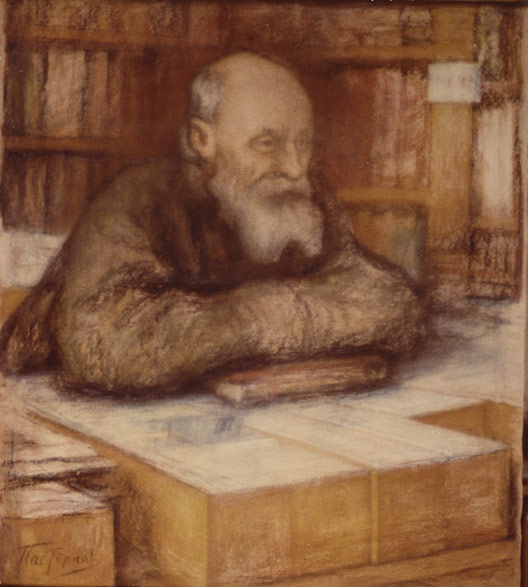 |
| Only known portrait of Nikolai Federov |
Federov's techno-utopianism also carries within it a distinctively reactionary and authoritarian quality. The common task can only be initiated after the unification of the nations of the world under the benevolent autocracy of the Tsar and the leadership of Orthodox Russia (Russian Orthodoxy has often been noted to have a peculiar messianic concept of nationalism- the Russian Empire as the only legitimate successor to the authority of Rome and Constantinople, and thus the last imperial bastion of the true Christian religion). Indeed, a major theme in his conception of the resurrection of our ancestors is that this would involve a return of true, patriarchal authority. Humanity would collectively rediscover its roles as sons and daughters, brothers and sisters, in the true human family with the return of each lost generation, and find freedom in obedience to proper authority.
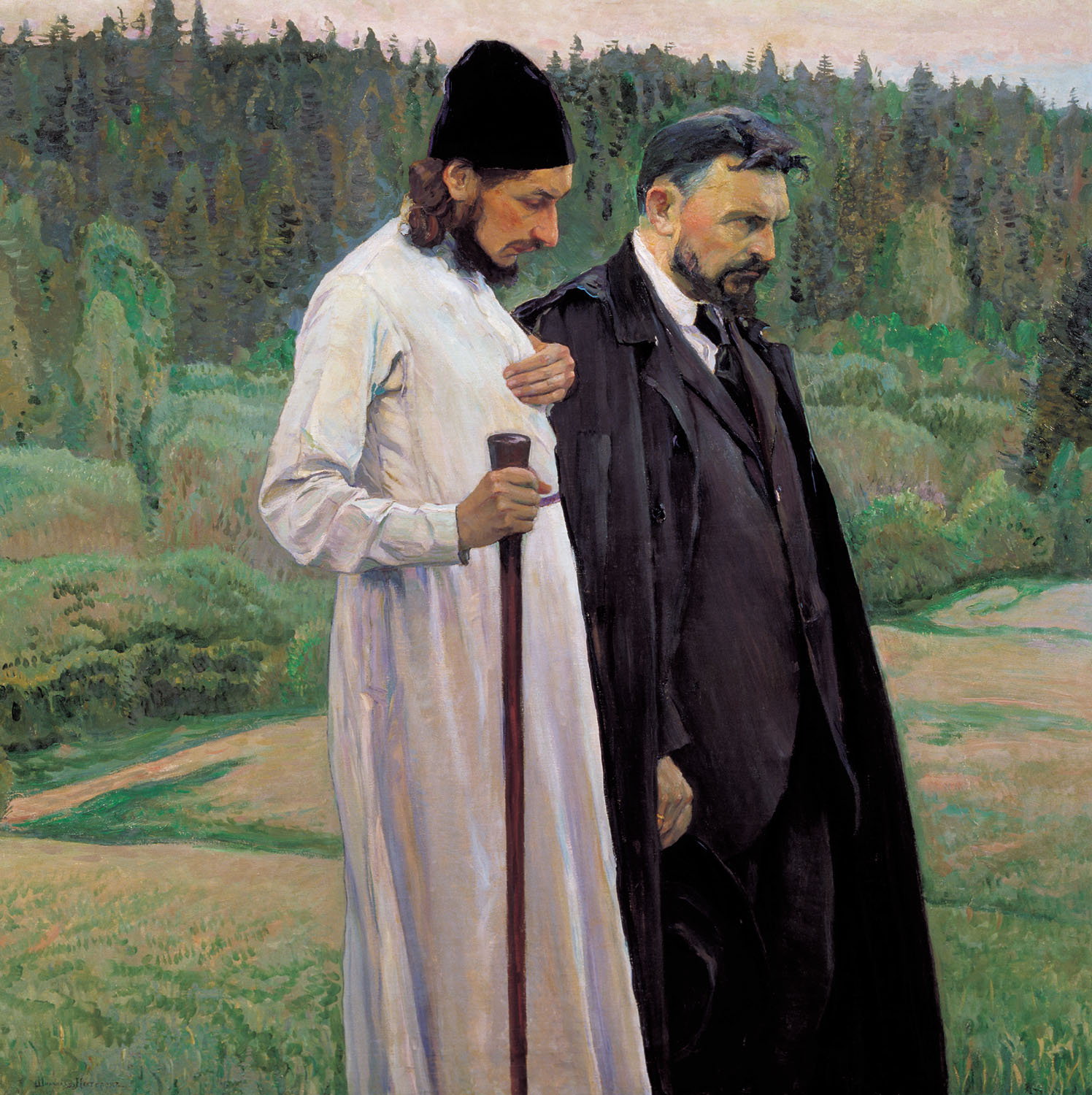 |
| Pavel Florensky (in white) and Sergei Bulgakov |
Cosmism after Federov branches in many directions, but always maintains the broad theme of perfecting the world through spiritually enlightened science. Emphasis does shift at many points though: Solovyov had little interest in science and was more concerned with utilising the occult to create a new form of androgynous human, and Bulgakov writes not of conquering nature but of developing a spiritual 'economy' of all things, understood more in the sense of husbandry than ownership and control. The overtly religious characteristics of Cosmism were essentially dismissed or actively down-played during the Soviet era, with more focus being put on the idea of engineering a new form of socialist human and perfecting the environment through central control and mass labour projects. Florensky's religious convictions were tolerated largely due to his technical brilliance, playing an important role in the electrification of Russia, though he'd ultimately be executed.
Contemporary Cosmism is still substantially more secular than it was in the past, but there has been a revived interest in the spiritual and occult writings of the Cosmists; this is perhaps because so much of their scientific thought can now be falsified (for example, Federov calls for us to build great cones that would allow us to direct the Earth's electro-magnetism and pilot the planet around the universe in pursuit of the dust of our ancestors), while the esoteric dimensions of Cosmism are something that can be taken as being 'beyond reason', and thus outside the clutches of positivist science.
The sheer optimism and vitality of Cosmism, and the surprising ease with which it combines ancient tradition with futurism, science with spirituality, is deeply appealing. It is difficult to not be thrilled by Cosmist thought, even if this is only in an aesthetic sense. In particular, the utopian (though often totalitarian) ideal of taking complete control of our own destiny and environment is intoxicating, even if it is misguided in many ways. Ultimately, the foundational ideal of Cosmism is that life can conquer death, and even if that isn't an ideal we can ever accomplish, it is very difficult to resist the urge to try.
Sunday, 5 July 2015
True Detective: Some Thoughts
Caution, spoilers
Although its most direct references to weird fiction are, of course, to Robert W. Chambers and Ambrose Bierce (namely 'Carcosa' and 'The King in Yellow'), it is the spirit of H. P. Lovecraft that most pervasively haunts True Detective. Now, Lovecraft of course appropriates the names 'Carcosa' and 'The King in Yellow' for himself and his own cosmo-mythology, but that's not what I'm talking about here. True Detective is the most purely Lovecraftian thing I've ever seen on television.
Although its most direct references to weird fiction are, of course, to Robert W. Chambers and Ambrose Bierce (namely 'Carcosa' and 'The King in Yellow'), it is the spirit of H. P. Lovecraft that most pervasively haunts True Detective. Now, Lovecraft of course appropriates the names 'Carcosa' and 'The King in Yellow' for himself and his own cosmo-mythology, but that's not what I'm talking about here. True Detective is the most purely Lovecraftian thing I've ever seen on television.
The Lovecraftian elements are not arrived at through simple name-dropping, though that certainly helps. Something much more subtle and clever happens in True Detective. It hardly needs to be said that much of Lovecraft's legacy is derived from the new pantheon of monstrosities he gives us, but it should also be remembered that he was far more than a simply pedlar of novel beasts and terrors: what Lovecraft does with great skill is endow the familiar with an otherworldly atmosphere. The very soil beneath our feet becomes infested with entities of unspeakable age and power. Lovecraft is able to warp the world we take for granted into something profoundly different and disturbing. He can twist things, take what you know and turn it inside out, force you to recognise how limited and illusory your understanding of the world is.
On a level of sheer aesthetics, True Detective is certainly able to achieve something like that. It implants the idea in the viewer's mind that behind the ordinary is something abnormal and threatening. As well as that, there is just something about the way TD is shot that makes the landscape, the endless swamps and always-in-the-distance industrial edifices unsettling, and I'm not sure what. It feels as if there is a quintessential element within the environment that just makes it wrong somehow, an element that cannot be easily defined. It's just there.
The show's cosmic pessimism and nihilism is very much worth mentioning here (the ending not withstanding). Cohle does more-or-less literally quote Thomas Ligotti (imagine a more disturbed H. P. Lovecraft, and you've got an idea of what Ligotti is like), who is possibly the most pessimistic writer I've ever come across. One of Lovecraft's most important characteristics is that his monsters are not 'evil' as such, they generally don't hold any direct malice towards humanity: they're just indifferent towards us, utterly so. To them, we're prey, or a nuisance, or occasionally entertaining playthings- but they are so far beyond us, so different, so purely alien that their motives cannot be grasped, and using words like 'good' and 'evil' to describe them is as absurd as calling the sun 'cruel' for giving you skin cancer. Cohle is a character who has grasped the uncaring nature of the universe, the absence of purpose, of grand narratives, of moral absolutes. That is where much of Lovecraft's horror lies: Cthulhu doesn't want to drive you mad, he just will.
These broad thematic strokes aside, the two most direct nods towards Lovecraft are somewhat blended together: the heavy hints at degenerate heredity and atavism, and the presence of a cult. The show is littered with references to Devil worship in the woods, of peculiar blends of Voodoo and folk-religion (and the use of mainstream religion to mask dark esotericism), culminating in Cohle's encounter with the bizarre and never-explained idol of The King in Yellow in the equally bizarre and unexplained Carcosa. Exactly what is it that motivates the killings? How does Childress have such a powerful affect on people? Why is any of this happening? At the end of the show, all we have are a few culprits, a few bad people who were doing bad things: but their motivations are never explained, not even remotely. It is obvious that a substantial conspiracy, going all the way up to high-office, is involved throughout the State, perpetrating and covering up murder, abduction and child abuse, and although sexual perversity is certainly part of the motivation... that just doesn't feel like the whole story, does it? Something more was going on there, in that house, in those tunnels. Something that cannot be grasped except at the expense of sanity. Cohle certainly glimpses it with his vision of a great vortex in outer space, and the thought of it disturbs Marty sufficiently that he has no desire for the details of what was found there, what that family had been doing there for so long.
It was absolutely the right decision for the show to not tell us why any of this was happening, what these people sort to accomplish with their deeds, if anything. The feeling it leaves behind is that we, the viewers, have been shown a glimpse at a hidden world, one just behind the veil of convention and assumption, containing a presence we simply can't believe exists, and yet is sharpening its claws and eyeing us intently.
Sunday, 28 June 2015
Don't Worry, Still Here- Apologies and News
As it's been an embarrassingly long time since I last posted anything on here, and I'm still getting at least a few hits every day, it feels worthwhile to at least twitch and moan a little to prove I'm still alive.
I haven't written anything new because I haven't thought of anything interesting to say. Most of my spare time has been going on trying to learn German and, for no real reason other than curiosity, reading up on Buddhism. I'm also still working on stuff for the ever-enjoyable Project Praeterlimina (we have Things You Can Buy). I've also been working my way through a nice fat collection of essays on Accelerationism in preparation for a talk I'll be giving in September at The Catalyst Club. I'll post my notes on here too, and I'll try to get something I feel worth sharing on here together in the next few weeks. I'm also half-considering trying to *takes deep breath* reading Being and Time all the way through, and trying to keep notes on it as I go. If I do manage to do this, I will try and post things up here relating to that.
In other news, for those of you who wonder what my voice sounds like, rejoice! A friend and I are planning on starting a podcast later this year, hopefully around November time. The general plan is that we'll pick a topic and try to talk about it in as interesting and entertaining a way that we can. Whether not not we'll succeed at it- I have no idea, but it will give me something to do.
Topics we've decided upon in advance include: Anti-Oedipus, Accelerationism and Heidegger. Feel free to make other suggestions in the comments, if you are so inclined.
Finally, some of my friends and I are vaguely planning a new writing project in which we'll explore the now mostly dead genre of, as we are provisionally calling it, British Science Weird. This should be an exploration of the peculiar mix of the provincial and cosmic in British SF, fantasy and horror over the last century, for example in the works of John Wyndham. There's literally no time scale for this at all, but when something does happen, I'll let you all know.
That's essentially it right now. As ever, stay tuned.
Subscribe to:
Posts (Atom)