I've been toying with a conceptual dichotomy for a while. It's probably not tremendously original, but it's helping me clarify my thinking a little. And hopefully writing about it here will allow me to polish my ideas further. I'd advise anyone unfamiliar with accelerationism to read my previous post on it before continuing (though it's worth mentioning that my understanding of accelerationism in general and its leftwards current in particular has developed since the writing of that piece).
I propose anti-modernism be viewed as having two potential directions. One I'd like to call 'accelerationist' if that hadn't already been coined, so we might perhaps call it the impulse to go beyond, or 'beyonder'. That is, responding to the various deficiencies and pathologies of modernity with a desire to push ahead, to traverse modernity and seek something beyond it. In other words: 'the way out is through.'
I call the other direction 'reversalist'. Modernity is an aberration, a mistake. One cannot be expected to find a way out by going 'through' it any more than one would expect to cure cancer by letting it 'sort itself out'. The only option is to excise the tumour. As such, one must seek to return to how things were before the aberration. This may be framed as a need to 'rediscover' the eternal truths of morality and the social order. 'The way out is to go back.'
I am not saying these definitions are absolute. I am just throwing out some thoughts that I have had for public inspection and criticism. The act of writing them down, in and of itself, helps me shape and understand them.
Anyway...
I find these definitions useful as they cut across the left/right dichotomy. One can argue that the right has a greater tendency towards the reversalist than the beyonder orientation, but one can find many on the left who seek a 'return' of some kind. The left-reversalist position generally finds modernity synonymous with capital itself, an alienating (and alien) force that destroyed the 'genuine authenticity' of the organic community of pre-modernity, even if that community existed in the context of its own set of injustices, i.e. feudal hierarchy, women regarded essentially as property and so on. Disdain for technology is also often common. Jaques Camatte's primitivism is an example of this. Such an attitude is common in environmentalism in its more radical incarnation, often suffused with nostalgia and, I'd argue, a naive understanding of life in pre-modernity. The Voluntary Human Extinction Movement, with its desire to rectify the great error that is humanity and return the biosphere to a pre-human state, may be described as either the absolute apotheosis of this position, or its moment of purest self-parody, depending on one's generosity.
The right-reversalist position may also contain an element of anti-capitalism, although generally in favour of some form of integralism or national socialism (though not necessarily National Socialism per se) over egalitarian, communal socialism. 'Rediscovery' or a 'homecoming' of some kind is generally the spirit of this position. Rediscovery of tradition, in either the weak or strong, capitalised sense of the word (Burke vs Evola and Guénon), restoration of legitimate authority (often monarchical), resurrection of the nation or race as a whole. Glorification of the past, especially a past characterised with imperial splendour, and a desire to return to it is key. It may not be a desire to return to 'how things were' simply because of their status as things passed. Rather, if Traditionalism is at the core of this tendency, the past is held up as an example of societies that were ordered according to values and principles considered eternal and perennial. The past is a thing to be returned to simply because it was ordered correctly, before the great error of modernity.
The beyonder current is well manifested in left-utopianism (anyone else remember that?). Pushing forward through this 'stage' in history, past capitalism into socialism and communism. Often, 20th Century communism displayed simply an outright rejection of the contemporary in favour of pursuing the future, or would attempt to outdo capitalism at its own game in terms of economic growth and prosperity. Left-accelerationism, to which I merrily confess the deepest of sympathies, is the most exciting manifestation of this position that I'm presently aware of. It possesses both a striking awareness of the problems of modern life with an impulse to rectify them which, I argue, is ultimately far more grounded in reality than the standard, insurrectionist response is. In seeking to turn modernity's successes against its failures, and to go beyond them into something altogether new, it captures the spirit of the beyonder impulse quite perfectly.
Much the same can be said of right-accelerationism, which we might as well call 'anarcho-techno-capitalism', though it lacks the sheen of utopianism. It identifies different problems with modernity than its leftwards twin does, but it still holds that the solution to the deficiencies of the contemporary is to go forwards rather than backwards. It is not a position that can be accused of nostalgia, as it draws upon what is useful from both the past and the present, the only worthwhile measure being its helpfulness. If it is 'Traditionalist' it is only in the loosest sense, the 'eternal law' being merely the laws of nature, its 'mysticism' being that of the Cthulhu Cult, rather than anything with regal grandeur.
Fascism was, arguably, a manifestation of this impulse as well, presenting itself as a force of renewal, both radically modernising the nation and restoring it to its past glory. The Futurists in Italy, with their paeans to technology, violence and velocity, and deep disdain for nostalgia and old things, and found themselves bedfellows with the Fascists. Nazism similarly presented itself as hostile towards the reactionary as well as the progressive. Something similar may be said of the Conservative Revolutionary Movement more generally, but that is pushing the boundaries of my knowledge.
A more problematic case is the Russian cosmists. Federov sought the past via way of the future. The powers of science and technology resurrecting the dead, unifying the world under the legitimate authority of the Tsar, the Church Fathers and Biblical Patriarchs, bringing the old prophets back to guide us more properly than we can guide ourselves. He sought an escape from modernity to the past via way of the future; less a revolution than a restoration. This might thus perhaps be called a reversalist position but here we see the boundaries becoming blurred to the point of non-existence.
Finally, where to place Neoreaction? Right-accelerationism has found its home there, arguably synonymous with 'techno-commercialism'. But NRx is a sufficiently broad church to resist easy definitions along the axis I propose. Certainly Moldbug seeks a reversal of modernity, though again via way of the future, with his image of a patchwork of for-profit run corporate city states relying on drones and sovereignty protected with encryption (though elsewhere I understand he lends his support to traditional forms of despotism and even monarchy). And the strain of NRx that was, at least formerly as I've no idea where he disappeared to, identifiable with Michael Annissimov was of a distinctly reversalist tone, as are the 'Heroic Reactionaries', that I understand. I actually wrote something about this particular tension in NRx a while ago, though the Reactosphere never had the big split I expected it to. Indeed, if anything it's become disappointingly quiet, but I digress.
I suggest using a beyonder/reversalist axis simply to add another layer of definition to our understanding of politics and ideology. If anything it can help us identify peculiar parallels between left and right we might not expect to see. Anyway, none of this has been thought out in much detail, so I invite the reader to comment on any inaccuracies, inconsistencies or stupidities in this piece.
Tuesday, 9 February 2016

Saturday, 30 January 2016
True Detective season two
Spoilers
Ok, first things first: overall, no, it's not as good as season one.
Now we've settled that, we can assess it on its own merits (and failures).
Set in California, the story follows four central characters: three cops and a gangster aspiring to be a businessman. A corrupt politician, who the gangster, Frank (Vince Vaughn), is working with to buy land that is going to sky-rocket in value due to a new travel infrastructure development, is tortured and murdered. His death is used as an excuse to send two cops from outside the area, the City of Vinci, to investigate the rumoured massive corruption in that city's police force and government; thus two cops, Ani Bezzerides (Rachel McAdams) and Paul Woodrugh (Taylor Kitsch), are deployed to officially work the case of the murder while unofficially being on a dirt digging mission. Ani works with the corrupt detective Ray Velcoro (Colin Farrell), who has secretly been working with Frank for years, while Paul...smoulders with intensity a lot.
Are you with me so far?
Now, you might say that 'Well, that doesn't sound too complicated.' On the face of it, no. But, the story becomes increasingly difficult to follow as we join the characters descent into tighter and deeper and darker spirals of corruption. Frankly, the plot becomes virtually Byzantine, throwing off tendrils into the self-help craze of the 80s, rumours of the goings on at Bohemian Grove, as well as investigating the sheer corrosiveness of greed and power.
Further, four main characters was simply one too many. What's more, it's obvious who should have been cut: Paul. Now, I want to say that there was nothing wrong with the character as such, although he didn't get much development and I can't actually think of much to say about him except 'conflicted closeted gay man', and there was nothing wrong with Kitsch's performance. The problem was that the character, though compelling in his own right, added very, very little to the story. Indeed, the story could have carried on without him with only minimal tweaking, freeing up screen time to elucidate the very opaque plot.
In many ways, it felt like I was watching a first draft. There was great potential, but it desperately needed some tidying up. Indeed, HBO's Director of Programming has taken the blame for rushing the writer. If it there had been more focus, more direction, and some pretty brutal editing, it would have been far better than it was.
However, that's not to say that we didn't end up with something that was quite brilliant in its own right.
Now, although the story was very difficult to follow, if you try hard enough, you can make sense of it, and although it is unnecessarily convoluted, it still had me interested enough to follow it through to the end. And the pay-off was actually quite well executed. They'd wisely killed Paul off in the penultimate episode so we could focus on the genuinely very cool characters of Ray, Ani and Frank. What's more, it goes into some really interesting areas. Although there's not much focus on these aspects of the story, it was still pleasing to see something talking about the excesses and plain weirdness of the self-actualisation, alternative mental health brigade. There's the darkness surrounding 'men of influence' and what they do behind closed doors, too. A key thread throughout is the 'exclusive' parties where politicians, police and businessmen alike gather for sybaritic shenanigans galore, going from the plain old debauched to the murderous. This is, in my opinion, an obvious allusion to the Bohemian Club, an elite men's only club which has been dodging rumours of everything from being a glorified college fraternity to practising Pagan rituals for decades.
The music and cinematography are as strong as anything season one produced. The image of California it creates is not one of glamour and beauty but seediness and waste. The camera lovingly pans over industrial parks, deserts, waste lands and poisoned soil, the music raising these scenes into art in their own right. The title sequence is certainly at least as good as one's.
None of the performances fell flat, and all the characters were at least interesting. When I heard about the inclusion of more female characters, I did greet this with suspicion. Not, of course, because I don't think a female lead can be as compelling or generally cool as a male lead, but because there had been criticism levelled at season one for its overtly male focus, and I feared that we'd end up with some two-dimensional female characters that added nothing: I couldn't have been more wrong. Although no one in two is anywhere near as awesome as Rust was, Ani could give him a run for his money. She's intelligent, deep, complex, insightful and just awesome. Kelly Reilly plays Frank's wife Jordan, but she's no typical mobster's kept woman. She's forthright and decisive, staying with her husband when the chips are down because she chooses to. Indeed, I really bought into both of their performances as a couple.
Speaking of which: Vince Vaughn is brilliant in this. He plays Frank with a curious mixture of strength and sensitivity, as someone who is desperately trying to escape from his past into the legitimacy of 'real' business. Easily one of the key presences in the series, a thoughtful and intriguing character handled very well. However, it is Colin Farrell who really stands out as the tortured, crumbling ruin that is Ray Velcoro, a cop who is increasingly finding himself with little to live for.
Velcoro is a man whose life has been on a downwards incline for years. About ten years before the events of the show, his wife was sexually assaulted, and the name of the man who was responsible given to him by Frank. This decision, this giving in (one might say), is the point of no return. His wife divorces him in disgust for killing the man supposedly responsible for her rape, and is threatening to cut off all contact between him and his son (who may not even be his anyway) due to Ray's ultimately poisonous aura. He sinks further into a substance abuse, working closer and closer with Frank in a relationship that is oddly co-dependent. It's worth watching just for him.
Overall, this is something worth seeing, but don't expect to see season one again. Pizzolatto has demonstrated his boldness and daring as a writer by shying away from emulation, and like I've said already, if he had just been given more time one feels that this would really, really stand out as a modern classic of crime drama. Sadly, that was not quite to be.
A flawed masterpiece, to be sure, but worth your time all the same.
Ok, first things first: overall, no, it's not as good as season one.
Now we've settled that, we can assess it on its own merits (and failures).
Set in California, the story follows four central characters: three cops and a gangster aspiring to be a businessman. A corrupt politician, who the gangster, Frank (Vince Vaughn), is working with to buy land that is going to sky-rocket in value due to a new travel infrastructure development, is tortured and murdered. His death is used as an excuse to send two cops from outside the area, the City of Vinci, to investigate the rumoured massive corruption in that city's police force and government; thus two cops, Ani Bezzerides (Rachel McAdams) and Paul Woodrugh (Taylor Kitsch), are deployed to officially work the case of the murder while unofficially being on a dirt digging mission. Ani works with the corrupt detective Ray Velcoro (Colin Farrell), who has secretly been working with Frank for years, while Paul...smoulders with intensity a lot.
Are you with me so far?
Now, you might say that 'Well, that doesn't sound too complicated.' On the face of it, no. But, the story becomes increasingly difficult to follow as we join the characters descent into tighter and deeper and darker spirals of corruption. Frankly, the plot becomes virtually Byzantine, throwing off tendrils into the self-help craze of the 80s, rumours of the goings on at Bohemian Grove, as well as investigating the sheer corrosiveness of greed and power.
Further, four main characters was simply one too many. What's more, it's obvious who should have been cut: Paul. Now, I want to say that there was nothing wrong with the character as such, although he didn't get much development and I can't actually think of much to say about him except 'conflicted closeted gay man', and there was nothing wrong with Kitsch's performance. The problem was that the character, though compelling in his own right, added very, very little to the story. Indeed, the story could have carried on without him with only minimal tweaking, freeing up screen time to elucidate the very opaque plot.
In many ways, it felt like I was watching a first draft. There was great potential, but it desperately needed some tidying up. Indeed, HBO's Director of Programming has taken the blame for rushing the writer. If it there had been more focus, more direction, and some pretty brutal editing, it would have been far better than it was.
However, that's not to say that we didn't end up with something that was quite brilliant in its own right.
Now, although the story was very difficult to follow, if you try hard enough, you can make sense of it, and although it is unnecessarily convoluted, it still had me interested enough to follow it through to the end. And the pay-off was actually quite well executed. They'd wisely killed Paul off in the penultimate episode so we could focus on the genuinely very cool characters of Ray, Ani and Frank. What's more, it goes into some really interesting areas. Although there's not much focus on these aspects of the story, it was still pleasing to see something talking about the excesses and plain weirdness of the self-actualisation, alternative mental health brigade. There's the darkness surrounding 'men of influence' and what they do behind closed doors, too. A key thread throughout is the 'exclusive' parties where politicians, police and businessmen alike gather for sybaritic shenanigans galore, going from the plain old debauched to the murderous. This is, in my opinion, an obvious allusion to the Bohemian Club, an elite men's only club which has been dodging rumours of everything from being a glorified college fraternity to practising Pagan rituals for decades.
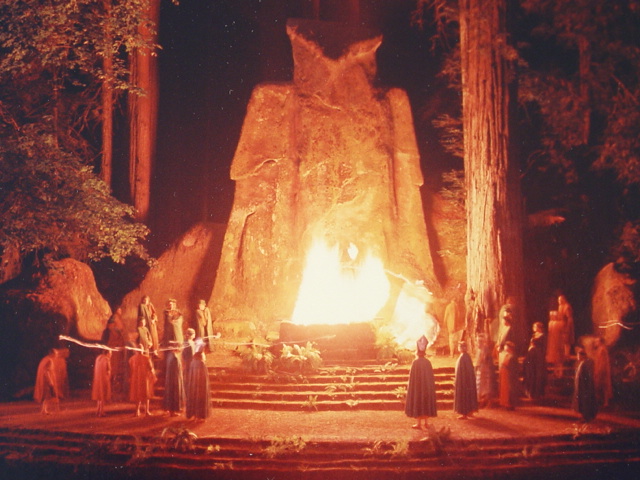 |
| It's definitely not weird that we do this! |
The music and cinematography are as strong as anything season one produced. The image of California it creates is not one of glamour and beauty but seediness and waste. The camera lovingly pans over industrial parks, deserts, waste lands and poisoned soil, the music raising these scenes into art in their own right. The title sequence is certainly at least as good as one's.
Speaking of which: Vince Vaughn is brilliant in this. He plays Frank with a curious mixture of strength and sensitivity, as someone who is desperately trying to escape from his past into the legitimacy of 'real' business. Easily one of the key presences in the series, a thoughtful and intriguing character handled very well. However, it is Colin Farrell who really stands out as the tortured, crumbling ruin that is Ray Velcoro, a cop who is increasingly finding himself with little to live for.
Velcoro is a man whose life has been on a downwards incline for years. About ten years before the events of the show, his wife was sexually assaulted, and the name of the man who was responsible given to him by Frank. This decision, this giving in (one might say), is the point of no return. His wife divorces him in disgust for killing the man supposedly responsible for her rape, and is threatening to cut off all contact between him and his son (who may not even be his anyway) due to Ray's ultimately poisonous aura. He sinks further into a substance abuse, working closer and closer with Frank in a relationship that is oddly co-dependent. It's worth watching just for him.
Overall, this is something worth seeing, but don't expect to see season one again. Pizzolatto has demonstrated his boldness and daring as a writer by shying away from emulation, and like I've said already, if he had just been given more time one feels that this would really, really stand out as a modern classic of crime drama. Sadly, that was not quite to be.
A flawed masterpiece, to be sure, but worth your time all the same.
Tuesday, 5 January 2016
Review: The Glass Bees by Ernst Jünger
Thanks to Rowan Lock for the biographical details, and general assistance with writing.
You can get hold of the copy of The Glass Bees I read here.
You can get hold of the copy of The Glass Bees I read here.
Ernst Jünger was one of the true luminaries of the
intellectual Right in the 20th century. A popular hero of the First World War,
famous for his memoir of the conflict entitled The
Storm of Steel, he became aligned
with the German conservative revolutionary movement in the interbellum years,
and as such advocated a radical, authoritarian, militarist nationalism. Despite this, he never made the fatal gesture Heidegger made, and was never
associated with National Socialism; his relationship with Nazism began as
coolly ambivalent, progressing into antipathy and finally open hostility (he
was even peripherally involved with 20 July Plot to assassinate Hitler). This
being said, his contribution to political theory outside his initial context
was, essentially, minimal. However, he was regarded as a figure of great literary
stature in post-war Europe. He was a prolific novelist, and his incredibly long
lifespan (over a century) gave him an enviable vantage point to comment from: he was a grown man when the German Empire collapsed, he was present
during the rise and fall of the Third Reich, and lived to see the reunification
of Germany (comfortably outliving the German Democratic Republic). His fans
included such contradictory figures as Hitler, Goebbels,
Francois Mitterand, Thomas Mann and Bertolt Brecht. As well as writing, he was
also a well-educated botanist and entomologist. He was even one of the very
earliest experimenters with LSD. He was a man who embodied the very paradoxes
and contradictions of recent European existence.
The Glass Bees is a novel about Captain Richard, a retired cavalryman-turned-tank-inspector. He's been offered an interview for a job working for Zapparoni, a technology magnate who embodies the Zeitgeist of modernity perfectly, and is depicted almost as a synthesis of Walt Disney and Steve Jobs, only infinitely cooler. Zapparoni's company makes the finest automata in the land, but these aren't the clunky mechanoids you might expect, they're rather more like the kind of tech that we have here-and-now. They are modest, ubiquitous, labour saving devices, tiny robots performing a host of domestic and industrial tasks. That isn't the limit to Zapparoni's vision though, he is also a purveyor of cinematic products, his automata bringing characters from myth and legend to all-too convincing life (in other words, animatronics). The vividness of the distractions he produces is, however, somewhat disquieting:
Children, in particular, were held spellbound [by his films]. Zapparoni had dethroned the old stock figures of the fairy tales...Parents even complained that their children were too preoccupied with him.
Richard is not a man of his time, arguably like Jünger himself. He harks back to the glory days of warfare and conflict that still felt human, battles fought with flesh and steel, and not simply with mechanisms and calculations. He feels a particular disgust at the kind of dismemberment produced by the technics of modern warfare, remarking that one doesn't find any stories of amputated limbs in the Iliad. That statement in particular becomes eerily prescient of the image of today's soldier wounded by an IED in one of our misadventures in the Middle East, missing an arm or a leg, but still alive: Richard mourns the loss of wars that killed you cleanly. Richard's world is one that has been chaotic and uncertain since his youth, when his country, Asturia, was plunged repeatedly into war, including civil war. He is a man whose principles were formed in a world now lost, and the one he finds himself in does not feel like an improvement.
[My father] had led a quiet life, but at the end he hadn't been too happy either. Lying sick in bed, he said to me: "My boy, I am dying at just the right moment." Saying this, he gave me a sad, worried look. He had certainly foreseen many things.
This is a deeply reactionary novel, and doesn't make for easy reading. Jünger's writing meanders, straying into lengthy digressions into his narrator's memory; his pace is languid, virtually glacial in fact. Although his prose is beautiful, even poetic, it feels incredibly indulgent and is often, frankly, dull. Very little happens as such in the novel, the bulk of it simply being Richard's recollections. And yet, what is curious is how this achingly slow piece of writing is able to convey the sheer speed with which modernity did away with the old world. The narrator, like Jünger, grew up in a world were the horse was still yet to be rendered obsolete by the automobile.
Jünger's clear concern is that technological progress will injure humanity very, very deeply.
Human perfection and technical perfection are incompatible. If we strive for one, we must sacrifice the other...Technical perfection strives toward the calculable, human perfection toward the incalculable. Perfect mechanisms...evoke both fear and a titanic pride which will be humbled not by insight but only by catastrophe.
What is curious here is that before the Second World War, Jünger advocated Germany's complete embracing of the technological age as the only way it could find victory in the next war. He felt that it was Germany's traditional, aristocratic hierarchy that prevented it from being able to properly mobilise itself in the total way the more levelled, egalitarian societies of the democracies were capable of doing (he discusses this in his work Total Mobilisation), and only by accepting the levelling effects of technological modernity could Germany once again find itself triumphant. Perhaps by the time of writing The Glass Bees Jünger had simply become disenchanted with the fury of warfare.
Elsewhere Richard, and maybe Jünger through him, speaks of the loss of the simple 'joy' of labour, of working the earth, of harvesting crops, of the well-deserved rest at the end of the long day, and how this has been traded in for labour that is certainly easier, and leisure time that is longer, but doesn't carry the same weight of satisfaction. The fear that we have lost much and gained little except damnation in return is the central theme of this book.
Zapparoni himself, in fact, has utilised his vast wealth and power to create a private world at first seemingly devoid of the artefacts that have made his name. He has a residence located within the grounds of his plant (which Bruce Sterling, in his introduction, remarks is not dissimilar to the campus feeling of Silicon Valley) in the form of a converted abbey. Richard explores its private library, finding books on Rosicrucianism and other occult sciences, and is later sent down the path to a cottage that comes close to the very Platonic Form of idyllic country residences. What is curious here is that this retreat from modernity has only been made possible by Zapparoni's very success at the practices and theories that Richard feels have destroyed the simple authenticity of the old world. How might this be read? Perhaps Jünger is suggesting that the only way back into the world that has been lost is to pass through the modern one, presuming we are capable of surviving it, and to use its mechanisms and ingenuity to recreate a new version of the old.
There's a feeling of resignation in this novel. Jünger isn't really calling on us to take up arms against the machines. His constant allusions to astrology suggest that he feels that there was something inevitable to what we now find ourselves in. It is our bad luck to find ourselves in the midst of it, but a way out might be found if we can weather the storm of the new. This being said, Richard repeatedly describes his attitude as 'defeatist'. Perhaps the more subtle suggestion Jünger is making here is that things only became inevitable when we decided we can't stop them.
I'm left feeling torn by this book. I share Jünger's concerns about the insidious nature of these devices we're now surrounded by, and yet the past he (or Richard) is seemingly appealing to is one that is forever out of reach, and if we were to find ourselves in it, it wouldn't be what we wanted. Consider the above statement about how now modern war doesn't kill one cleanly, that we now have the mutilated, dismembered wounded: we can equally well read this as 'Human technical ingenuity is now such that it can protect us, admittedly only limitedly, from the extremities of human malice.'
The question posed by modernity is one that has not yet had a satisfactory answer. Indeed, the question itself has yet to be fully formulated. Jünger's contribution to understanding the condition that we find ourselves in is an important one. If nothing else, he can remind us how incredibly recent all of this still is. Up until only very recently, there were people alive who'd fought in the war of Kings, Kaisers and Tsars, witnessed the rise of all the great and terrible varieties of attempted Utopia the last century produced, saw a human being walk upon the surface of the Moon (an image which disturbed Heidegger no end), and died in the age of Facebook.
It really is anyone's guess where this will all lead.
2016 Reading List Progress
List 1:
2. Sacred Drift: Essays on the Margins of Islam by Peter Lamborn Wilson
3. Notes from the Underground by Fyodor Dostoyevsky
4. United States of Paranoia by Jesse Walker
5. Axiomatic by Greg Egan
Sunday, 3 January 2016
An Experiment in Self-Discipline
I suppose this is something of a new year's resolution. Usually, I jump between different books depending on my mood. Inevitably, this leads to me staring many more books than I ever actually finish. I don't think there's anything wrong with not finishing a book in and of itself: life's too short to spend it reading uninteresting books. However, abandoning a book simply out of laziness is no excuse. As such, I'm going to try something.
I'm going to set myself short reading lists this year. Each list will consist of five books, alternating between fiction and nonfiction. After the final book on a list has been completed, and new one is drawn up. This might be designed to build on something I found especially interesting in my last list, or it may take me in a whole new direction. I'm also going to try and review what I've read, if I feel up to the task (I never wrote a review of Houellebecq's novel Submission simply because I didn't think I could do it credit).
I will post the lists on here. I'm also open to suggestions about what to include, though I am trying to get through the private library I've accumulated over the years, so if I don't already have a copy of the suggestion, I'll have to think carefully about its inclusion. I will also write a general assessment after finishing the last book on each list. I reserve the right to abandon a book in favour of another one if it proves especially tedious.
List 1:
1. The Glass Bees by Ernst Jünger
2. Sacred Drift: Essays on the Margins of Islam by Peter Lamborn Wilson
3. Notes from the Underground by Fyodor Dostoyevsky
4. United States of Paranoia by Jesse Walker
5. Axiomatic by Greg Egan
1. The Glass Bees by Ernst Jünger
2. Sacred Drift: Essays on the Margins of Islam by Peter Lamborn Wilson
3. Notes from the Underground by Fyodor Dostoyevsky
4. United States of Paranoia by Jesse Walker
5. Axiomatic by Greg Egan
Saturday, 26 December 2015
Chasm by Nick Land: Review
Chasm is Nick Land's latest offering to the world of (e-)letters, and it's certainly a welcome addition to my Kindle library. Although, it's very, very odd (but then again, if you know the first thing about Land you knew to expect, and, indeed, welcome that).
The writing is a lot tighter than in Phyl-Undhu, his previous work of fiction, released last year. His focus is much sharper, the narrative strays less (don't get me wrong, as I've already attested to, Phyl-Undhu is brilliant), and yet it's much more difficult to say what the hell Chasm is about. P-U remained in conceptual territory I have a fairly good familiarity with (The Great Filter, Fermi, the simulation hypothesis), while everything here is much more abstract, which is entirely the point: it contains an appendix called 'Manifesto for an Abstract Literature' after all. Land's inner maths (Qabalah) nerd was obviously having a lot of fun here, and my comparative numerical illiteracy blunted my enjoyment a little.
The story follows five men in a boat ('Oh, is he doing Heart of Darkness?' I asked myself early on. Well, sort of.), sent out into the Pacific by the mysterious QASM corporation to dispose of something by dropping it into the Mariana Trench. The object in question is described as more of an absence than a presence, a block of unrelfective material which presumably contains something. This is pure MacGuffin of course, which Land more-or-less explicitly admits, but by Cthulhu it's creepy all the same. As the journey continues, the crew enter into a state of total insomnia...and yet, the lack of sleep doesn't keep them from dreaming...
This is pure Nick Land. There's much Lovecraft in the crew's decaying sanity, and the horror from the sea vibe, with delicious passages discussing the life that lives around deep-sea volcanic vents so far, far down that the sun's rays never reach down to them except in the form of the faintest of particle rays; the preoccupation with numbers; broken causality and linearity; suggestions of an alignment between corporate and 'deep state' interests. Like Phyl-Undhu, there's some interesting stuff in the appendices, which I don't think I've ever seen on Xenosystems so it may very well be unique to this publication. And again like Phyl-Undhu, this feels a lot like a puzzle that Land is expecting us to try and solve, though, for reasons that will become obvious when you read it, I'm not sure how willing I am to let this stuff too far into my head.
In terms of sheer construction, Chasm is better than Phyl-Undhu, though I must confess I enjoyed the latter slightly more. It gives you a taste of the wider world of its setting, without giving you too much to chew on, leaving you wanting more, which is always a good move for speculative fiction. I think Chasm is best approached as an experiment, rather than just the cleverer kind of weird story. It's an experiment in constructing a literature composed of hints and suggestions at the abstract, perhaps even the thing-in-itself, rather than giving us anything definite.
To quote the appendix:
The best monster is one you never see. Everyone knows that. The only disappointing moment in Alien is when you actually see the bloody thing at the end. A perfect horror story would be one where you never see anything, or hear anything, or even really know anything. It's one where you detect hints, notice clues, but can never quite correlate all of the knowledge in your mind together sufficiently to guess at the shape of the monster. That is what Land is doing, and he does it well.
There's not much more I can say, which is due to the nature of the beast in question, so I'll leave you here.
The writing is a lot tighter than in Phyl-Undhu, his previous work of fiction, released last year. His focus is much sharper, the narrative strays less (don't get me wrong, as I've already attested to, Phyl-Undhu is brilliant), and yet it's much more difficult to say what the hell Chasm is about. P-U remained in conceptual territory I have a fairly good familiarity with (The Great Filter, Fermi, the simulation hypothesis), while everything here is much more abstract, which is entirely the point: it contains an appendix called 'Manifesto for an Abstract Literature' after all. Land's inner maths (Qabalah) nerd was obviously having a lot of fun here, and my comparative numerical illiteracy blunted my enjoyment a little.
The story follows five men in a boat ('Oh, is he doing Heart of Darkness?' I asked myself early on. Well, sort of.), sent out into the Pacific by the mysterious QASM corporation to dispose of something by dropping it into the Mariana Trench. The object in question is described as more of an absence than a presence, a block of unrelfective material which presumably contains something. This is pure MacGuffin of course, which Land more-or-less explicitly admits, but by Cthulhu it's creepy all the same. As the journey continues, the crew enter into a state of total insomnia...and yet, the lack of sleep doesn't keep them from dreaming...
This is pure Nick Land. There's much Lovecraft in the crew's decaying sanity, and the horror from the sea vibe, with delicious passages discussing the life that lives around deep-sea volcanic vents so far, far down that the sun's rays never reach down to them except in the form of the faintest of particle rays; the preoccupation with numbers; broken causality and linearity; suggestions of an alignment between corporate and 'deep state' interests. Like Phyl-Undhu, there's some interesting stuff in the appendices, which I don't think I've ever seen on Xenosystems so it may very well be unique to this publication. And again like Phyl-Undhu, this feels a lot like a puzzle that Land is expecting us to try and solve, though, for reasons that will become obvious when you read it, I'm not sure how willing I am to let this stuff too far into my head.
In terms of sheer construction, Chasm is better than Phyl-Undhu, though I must confess I enjoyed the latter slightly more. It gives you a taste of the wider world of its setting, without giving you too much to chew on, leaving you wanting more, which is always a good move for speculative fiction. I think Chasm is best approached as an experiment, rather than just the cleverer kind of weird story. It's an experiment in constructing a literature composed of hints and suggestions at the abstract, perhaps even the thing-in-itself, rather than giving us anything definite.
To quote the appendix:
Abstract literature writes in clues, with clue words, but without hope. It is the detective fiction of the insoluble crime, the science fiction of an inconceivable future, the mystery fiction of the impregnable unknown, proceeding through cryptic names of evocation, and rigid designators without significance. The weirdness it explores does not pass, unless to withdraw more completely into itself. There is no answer, or even - for long- the place for an answer. Where the solution might have been found waits something else. Description is damage.
The best monster is one you never see. Everyone knows that. The only disappointing moment in Alien is when you actually see the bloody thing at the end. A perfect horror story would be one where you never see anything, or hear anything, or even really know anything. It's one where you detect hints, notice clues, but can never quite correlate all of the knowledge in your mind together sufficiently to guess at the shape of the monster. That is what Land is doing, and he does it well.
There's not much more I can say, which is due to the nature of the beast in question, so I'll leave you here.
Tuesday, 22 December 2015
Phyl-Undhu by Nick Land: Review
The good Mr Land has a new e-book out, Chasm. Buy it at once. I've not read it yet, but its publication gave me the well-needed nudge to do what I kept meaning to do, and go back and read Land's last offering, Phyl-Undhu, released about this time last year. Buy it at once also.
Phyl-Undhu (a friend has observed that this can be read as 'File Under') is a...I don't really know how to describe it. It's a work of experimental, conceptual horror with science fiction elements. In other words: it is pure Lovecraft. The characters, although substantially more fleshed out than HPL ever felt the need to do so, are largely secondary to the story and the ideas it's built around, and that's no bad thing. Horror often works best in the form of vignettes, I feel, by offering you fleeting glimpses of the Absolute Other. This isn't always the case, and character driven horror can work wonders, but there's still a certain unique chill to the short horror story, or at most horror novella. Land is using a style like that here, not taking much time to build the world, hurrying the reader into the location where he wants them, relying on hints and suggestions to create the impression of the greater substance of the story's setting. He does this very well indeed.
It follows Alison and Jack Turner's attempts to fathom the depths of their young daughter's mind and world-view, which have become so disturbing that her fellow children at school are becoming increasingly traumatised by her presence, to the extent that one student attempts suicide. They realise that Suzy, their daughter, has dramatically changed since becoming involved in a deeply immersive video game. By 'deeply' I really mean 'totally'. Land doesn't tell us anything about the tech involved (the story is clearly set in a nondescript near-future), but it seems to involve a kind of Gibson-esque VR.
The game, of which we learn reasonably little, seems to be a kind of accelerated reality simulation. Suzy's character now lives in a very, very, very old world, and the only glimpse we get of the scale of this simulated world is the deeply ancient conurbation that's grown around the ruins of a space elevator, 'Ashenzohn' ('Ascension', surely?). The horror of Phyl-Undhu really lies in this. The game is heavily implied to be a solution to science non-fiction's most frightening monster: The Great Filter.
The Great Filter is a proposed solution to the Fermi Paradox, which can be summarised as follows - the Universe is very big and very old, thus life should be common enough to be noticeable throughout: so, where are the aliens? Why haven't we spotted evidence of at least one interstellar civilisation yet? The Great Filter may be the answer to that question. The Great Filter is an unknown force that radically reduces the probability of life creating an interstellar civilisation. It may apply at an early stage (i.e. whatever the Filter is, it may simply reduce the chance of life occurring in the first place, or of multi-cellular life occurring, or of intelligence occurring, and so on) or it may apply later (reducing the chance of agricultural civilisation, or of technological civilisation, or of space-faring civilisation, and so on). If the Filter is early, then we're probably ok: we passed it long ago. If it's late, then there's a greater chance that we still have it ahead of us. Maybe technological civilisations just don't tend to last long enough to become space-faring...
So what might the late-Filter be? Phyl-Undhu suggest a possibility. Technological civilisations may tend to become lost in their own simulated realities, finding them preferable to actual reality. There's any number of reasons this might be, including just standard 'decadence' or, more curiously, the notion that simulated reality contains more potential for discovery and ultimately value than 'natural' reality, especially if it turns out that interstellar travel is prohibitively difficult (i.e. no warp drives. Ever.). Land has speculated about time in many places, especially the idea that advanced technology can radically alter our perception of time: cyber-time making mockery of mere 'meat-time'. A simulated reality where a second of outside time can be minutes, or more, of internal time. The further down this rabbit hole we go, the less likely it is we can emerge...potential lifetime-upon-lifetime of rich, unpredictable experiences lying within the Matrix...why bother going somewhere as dull as Mars when you can enjoy oceans and oceans of simulated worlds?
I'm not going to describe the content of the simulation in too much detail, simply because you really ought to read this for yourself, but suffice to say that if you know what you're looking for in it, there's certain a shroud of Dark Enlightenment cast over it, giving it all a deliciously gloomy sheen.
Although, as it often the case with Land's fiction, it falls into the trap at points of being a little too cryptic, for the vast majority of the time the strangeness of it all feels more like a puzzle than something that's simply opaque for it's own sake, and it rewards a second reading. It also contains some cool articles previously published on Xenosystems, and perhaps most bizarrely, an oddly loving, unauthorised cameo from Scott Alexander (Scott didn't know about this until after the fact, though wasn't exactly displeased).
All in all, as ever, Nick Land is worth your time reading, regardless of what you may think about his views. It makes me wish he'd spend more time on this kind of cool, clever, experimental fiction than he does, and I'm very much looking forward to digging into Chasm over the Christmas holiday.
Land's publisher is Time Spiral Press, and if you want something even more esoteric than this, check out Ccru: Writings 1997-2003, which I've been thumbing through for the last few months.
Stay tuned for my thoughts on Chasm in the (hopefully near) future.
Phyl-Undhu (a friend has observed that this can be read as 'File Under') is a...I don't really know how to describe it. It's a work of experimental, conceptual horror with science fiction elements. In other words: it is pure Lovecraft. The characters, although substantially more fleshed out than HPL ever felt the need to do so, are largely secondary to the story and the ideas it's built around, and that's no bad thing. Horror often works best in the form of vignettes, I feel, by offering you fleeting glimpses of the Absolute Other. This isn't always the case, and character driven horror can work wonders, but there's still a certain unique chill to the short horror story, or at most horror novella. Land is using a style like that here, not taking much time to build the world, hurrying the reader into the location where he wants them, relying on hints and suggestions to create the impression of the greater substance of the story's setting. He does this very well indeed.
It follows Alison and Jack Turner's attempts to fathom the depths of their young daughter's mind and world-view, which have become so disturbing that her fellow children at school are becoming increasingly traumatised by her presence, to the extent that one student attempts suicide. They realise that Suzy, their daughter, has dramatically changed since becoming involved in a deeply immersive video game. By 'deeply' I really mean 'totally'. Land doesn't tell us anything about the tech involved (the story is clearly set in a nondescript near-future), but it seems to involve a kind of Gibson-esque VR.
The game, of which we learn reasonably little, seems to be a kind of accelerated reality simulation. Suzy's character now lives in a very, very, very old world, and the only glimpse we get of the scale of this simulated world is the deeply ancient conurbation that's grown around the ruins of a space elevator, 'Ashenzohn' ('Ascension', surely?). The horror of Phyl-Undhu really lies in this. The game is heavily implied to be a solution to science non-fiction's most frightening monster: The Great Filter.
The Great Filter is a proposed solution to the Fermi Paradox, which can be summarised as follows - the Universe is very big and very old, thus life should be common enough to be noticeable throughout: so, where are the aliens? Why haven't we spotted evidence of at least one interstellar civilisation yet? The Great Filter may be the answer to that question. The Great Filter is an unknown force that radically reduces the probability of life creating an interstellar civilisation. It may apply at an early stage (i.e. whatever the Filter is, it may simply reduce the chance of life occurring in the first place, or of multi-cellular life occurring, or of intelligence occurring, and so on) or it may apply later (reducing the chance of agricultural civilisation, or of technological civilisation, or of space-faring civilisation, and so on). If the Filter is early, then we're probably ok: we passed it long ago. If it's late, then there's a greater chance that we still have it ahead of us. Maybe technological civilisations just don't tend to last long enough to become space-faring...
So what might the late-Filter be? Phyl-Undhu suggest a possibility. Technological civilisations may tend to become lost in their own simulated realities, finding them preferable to actual reality. There's any number of reasons this might be, including just standard 'decadence' or, more curiously, the notion that simulated reality contains more potential for discovery and ultimately value than 'natural' reality, especially if it turns out that interstellar travel is prohibitively difficult (i.e. no warp drives. Ever.). Land has speculated about time in many places, especially the idea that advanced technology can radically alter our perception of time: cyber-time making mockery of mere 'meat-time'. A simulated reality where a second of outside time can be minutes, or more, of internal time. The further down this rabbit hole we go, the less likely it is we can emerge...potential lifetime-upon-lifetime of rich, unpredictable experiences lying within the Matrix...why bother going somewhere as dull as Mars when you can enjoy oceans and oceans of simulated worlds?
I'm not going to describe the content of the simulation in too much detail, simply because you really ought to read this for yourself, but suffice to say that if you know what you're looking for in it, there's certain a shroud of Dark Enlightenment cast over it, giving it all a deliciously gloomy sheen.
Although, as it often the case with Land's fiction, it falls into the trap at points of being a little too cryptic, for the vast majority of the time the strangeness of it all feels more like a puzzle than something that's simply opaque for it's own sake, and it rewards a second reading. It also contains some cool articles previously published on Xenosystems, and perhaps most bizarrely, an oddly loving, unauthorised cameo from Scott Alexander (Scott didn't know about this until after the fact, though wasn't exactly displeased).
All in all, as ever, Nick Land is worth your time reading, regardless of what you may think about his views. It makes me wish he'd spend more time on this kind of cool, clever, experimental fiction than he does, and I'm very much looking forward to digging into Chasm over the Christmas holiday.
Land's publisher is Time Spiral Press, and if you want something even more esoteric than this, check out Ccru: Writings 1997-2003, which I've been thumbing through for the last few months.
Stay tuned for my thoughts on Chasm in the (hopefully near) future.
Thursday, 19 November 2015
Markets, Regulation and Phages
Note: there's some disagreement about whether or not '(bacterio)phage' is an invariable noun or not. I'm going with this article on the matter.
Also, I'm very much a scientific layman, so please correct me if I misuse any terminology.
I woke up this morning to the news that scientists in China have discovered a bacterial mutation, in both livestock and humans, that is resistant to colistin, the 'last line of defence' antibiotic. Resistance to colistin has happened before, but this time the resistant gene is easily shared between bacteria. This is very bad. Somehow, this has not induced mass panic and calls from the leaders of the world to declare a War on Pan-resistant Bacteria. That is also very bad.
A lot of our current trouble comes not so much from the absence of new antibiotics (though this is a problem: we've not had a new antibiotic class since the late 80s), but from the misuse of the ones we currently have. To quote The Master Himself, back in 1945:
There is hope, however, as there often is. New antibiotics are in development, but more importantly, in my utterly unqualified opinion, there is phage therapy.
What is thus demonstrated is how damn complicated the relationship between the market, regulations and incentives actually is. A lack of proper, responsible regulation contributed to this situation in a big way, and now overly-strict regulations are holding us back from being able to fix this, or at least making it more difficult. Obviously, one thing that needs to happen is an increase in government spending on pure science. Creating more opportunities for scientific enquiry outside the structure of capital would be a fantastic step in the right direction, but so would properly calibrating market incentives. The plain fact of the matter is that the market is a fantastic mechanism for production and innovation, but the very nature of the profit motive limits it as well. It can be very difficult to convince anyone to spend on something purely speculative if they stand little obvious chance of making good on their investment.
I'm not one for moralising. The failures of capitalism are, as far as I'm concerned, no more 'evil' than the failure of a screwdriver to turn an egg into an omelette. This is just about the proper application of tools. Capitalism is a fantastic tool if directed appropriately, and so is state regulation. It's easier to think in extremes than in nuanced moderations, but there's a reason Aristotle locates virtue (understood more as 'skill' than anything pious) in the centre ground between excess and deficiency. It's not as if our only choice is between Murray Rothbard and Joseph Stalin.
Also, I'm very much a scientific layman, so please correct me if I misuse any terminology.
I woke up this morning to the news that scientists in China have discovered a bacterial mutation, in both livestock and humans, that is resistant to colistin, the 'last line of defence' antibiotic. Resistance to colistin has happened before, but this time the resistant gene is easily shared between bacteria. This is very bad. Somehow, this has not induced mass panic and calls from the leaders of the world to declare a War on Pan-resistant Bacteria. That is also very bad.
A lot of our current trouble comes not so much from the absence of new antibiotics (though this is a problem: we've not had a new antibiotic class since the late 80s), but from the misuse of the ones we currently have. To quote The Master Himself, back in 1945:
...I would like to sound one note of warning. Penicillin is to all intents and purposes non-poisonous so there is no need to worry about giving an overdose and poisoning the patient. There may be a danger, though, in underdosage. It is not difficult to make microbes resistant to penicillin in the laboratory by exposing them to concentrations not sufficient to kill them, and the same thing has occasionally happened in the body. The time may come when penicillin can be bought by anyone in the shops. Then there is the danger that the ignorant man may easily underdose himself and by exposing his microbes to non-lethal quantities of the drug make them resistant. Here is a hypothetical illustration. Mr. X. has a sore throat. He buys some penicillin and gives himself, not enough to kill the streptococci but enough to educate them to resist penicillin. He then infects his wife. Mrs. X gets pneumonia and is treated with penicillin. As the streptococci are now resistant to penicillin the treatment fails. Mrs. X dies. Who is primarily responsible for Mrs. X’s death? Why Mr. X whose negligent use of penicillin changed the nature of the microbe. Moral: If you use penicillin, use enough.What we have seen is the overuse of antibiotics worldwide. By making them too readily available, particularly for agricultural usage (this gene appears to have originated from treating pigs with colistin), as well as offering them for conditions antibiotics do nothing for such as the common cold, their effectiveness has been reduced over the last few decades. This an incredibly good example of the kind of multipolar problems Scott Alexander has described. The lack of suitable central co-ordination in the use of antibiotics, permitting individuals to pursue their own perceived rational self-interest has resulted in a potential catastrophe that could leave millions dying of previously treatable illnesses. And doesn't that perfectly illustrate the limitations of markets? Markets are fantastic at co-ordinating in many ways...but not in every way, and it's failure modes can be pretty dramatic.
There is hope, however, as there often is. New antibiotics are in development, but more importantly, in my utterly unqualified opinion, there is phage therapy.
For decades, patients behind the Iron Curtain were denied access to some of the best antibiotics developed in the West. To make do, the Soviet Union invested heavily in the use of bacteriophages — viruses that kill bacteria — to treat infections. Phage therapy is still widely used in Russia, Georgia and Poland, but never took off elsewhere. [source]Phage therapy never took off in the West largely because of the successes of antibiotic treatments. Phage therapy involves deploying specific bacteriophages (a form of virus that attacks bacteria), which then destroy the specific bacteria they are targeting. Unlike antibiotics, that will also damage the body's 'friendly' bacteria, the phage can be specific enough to only attack the pathogen. What is holding back research and development is, ironically considering my comments above, regulation. Laws in the US preventing the patenting of living things is a major barrier for pharmaceutical companies to invest in phage therapy: how will they make their money back if they can't patent the phages they've developed?
What is thus demonstrated is how damn complicated the relationship between the market, regulations and incentives actually is. A lack of proper, responsible regulation contributed to this situation in a big way, and now overly-strict regulations are holding us back from being able to fix this, or at least making it more difficult. Obviously, one thing that needs to happen is an increase in government spending on pure science. Creating more opportunities for scientific enquiry outside the structure of capital would be a fantastic step in the right direction, but so would properly calibrating market incentives. The plain fact of the matter is that the market is a fantastic mechanism for production and innovation, but the very nature of the profit motive limits it as well. It can be very difficult to convince anyone to spend on something purely speculative if they stand little obvious chance of making good on their investment.
I'm not one for moralising. The failures of capitalism are, as far as I'm concerned, no more 'evil' than the failure of a screwdriver to turn an egg into an omelette. This is just about the proper application of tools. Capitalism is a fantastic tool if directed appropriately, and so is state regulation. It's easier to think in extremes than in nuanced moderations, but there's a reason Aristotle locates virtue (understood more as 'skill' than anything pious) in the centre ground between excess and deficiency. It's not as if our only choice is between Murray Rothbard and Joseph Stalin.
Subscribe to:
Posts (Atom)